Planner System Update

It’s that time of year again! Everyone in the planner community is eyeing the 2025 planners and making their decisions about what is going to give them “planner peace” in the new year.

As for me, I think “planner peace” is like the Easter Bunny or Santa. Doesn’t exist. And that phrase is beginning to make my ass twitch.

Why am I so grumpy about planners, you ask?

If you have been reading this blog for a while, you can probably guess. You might remember my previous posts on my various misguided attempts to find the perfect (for me) planner to replace my bullet journal, and you’ve likely been expecting this post.

To catch you up if you haven’t been following along on this adventure… I first tried the Bullet Journal method back in summer of 2017. Then, during then pandemic when “planning” sort of seemed like a sick joke, I decided to try moving from a BuJo to dated planner (Passion Planner monthly). I don’t think I made it through even half of 2021 before I bailed and went back to the BuJo method.

I tried again in 2022 with a slightly different dated planner system (Midori monthly). That also didn’t work out. Then I made another attempt in 2023 with yet a different planner set up (Passion Planner weekly). Another fail by mid-year that had me trying the Hobonichi Techo half-year planner instead. I was convinced it was going to work because it had monthly, weekly, AND daily planner pages, which seemed to be what I was missing in my previous attempts to replace my BuJo.

And I was right. Mostly. That set-up worked well enough that I convinced myself to try the full year Hobonichi in 2024.

This year’s planner: a Hobonichi Techo 2024

However… there aren’t a lot of blank pages available in that planner for goal planning or what the BuJo folks call “collections” (ex: project task lists, notes, etc.). And, because I wanted to have a dedicated place to track my running, I got a running journal as well.

Running journal

In addition to those, I have a separate notebook for journaling, plus another for each of my writing projects.

The current in-progress notebook stack

It’s too much, and it’s making me want to return to my bullet journal. I was doing my best to hold off until January before making a change, but this past week I decided to give up and go back to the BuJo, at least for the rest of September.

The notebook I was using for my bullet journal before I switched to the dated planner still has about a hundred blank pages left. I think it’s nearly enough to get me through the rest of this year. So, I’m going to see if I can even remember how to BuJo, and see if it’s just the entire concept of planners that has been frustrated, or if I finally can find some “peace” by going back to the BuJo Method.

Expect an update sometime in December, when I commit to a 2025 planning system…

Tweaking My Planner System (Again)

Most of today was spent making progress on cleaning up the novel I’m working on, but I did spend a little time thinking about my 2024 planning system. In a previous post, I mentioned that I’ve switched from using a bullet journal to trying out the half-year Hobonichi Cousin. It’s been working well. Mostly. But there have been a few things I’m not entirely pleased with.

The first of those is that the Cousin doesn’t have a lot of blank pages for free-form planning and notes. So, if you want to do that, you’re limited to using the daily pages, or looking elsewhere. The more I tried to stay in the planner and work around this, the more frustrating it was to keep track of progress toward my quarterly and monthly goals. Eventually, I tried using Obsidian to fill in the gaps.

After months of trying to keep track of tasks across multiple notes in Obsidian and struggling to find a view that worked for me, I gave up. About a week ago, I started pulling all the tasks I’d created out of my Obsidian notes and moving them to my planner. The only problem was, I still had no place to put my goal and project planning. I think this is why some people end up using multiple planners. But I am determined to figure out how to make everything work in one.

The solution I’ve come up with is one that I’ve found by watching planning videos from other Cousin users on YouTube. That’s how I figured out that you can buy a thin companion notebook that has only about forty sheets in it. These notebooks are meant to slip into the back cover of your planner. Awesome! Problem solved!

Except, I live on a tiny island. I’d need to order these online, because there are no stores here that sell that sort of thing. And there is no way (given the absolutely slammed holiday mail situation on said tiny island) that these would arrive anytime soon. Best case, they’d likely be here a few days before the New Year.

Not to worry. I have a perfectly good bullet journal that I only used for three months. There is still at least half a notebook worth of blank pages in there. So, new plan! I am going to use my old bullet journal for noodling out 2024 goal and project planning. Once I have everything figured out, I’m going to copy it over onto one of the precious few blank pages in my Hobonichi Cousin.

Here’s how it’s going to work: There are exactly four blank pages in the planner. I’m going to use one for each quarter’s goals. Then I’m going to use the blank page at the start of each batch of monthly pages as a place to track all my monthly projects and task. This will be kind of like the right-hand side of the monthly spreads I used to do in my bullet journal.

I also have the start of a plan for how I am going to track my reading in the planner. I don’t have a good spot for doing any readathon spreads, though. But I have some ideas about how I want to handle that, and I have time to figure it out. I think the next Magical Readathon isn’t until April.

I’m going to keep using Obsidian. Overall, I like it. I think it works best for things like you would put into a “collection” in a bullet journal. So, lists of movies I want to watch or books I want to read, research and links for vacation planning, notes on what I want to remember to fix in my next edit pass on my book, a brainstormed list of tasks for a project, that type of thing. This is a great addition to my system because it’s digital and searchable and syncs across all my devices (you can’t hyperlink in a notebook). Plus, I definitely do NOT have a place (other than the daily pages) for that sort of thing in the Cousin.

Ultimately, I envision the Obsidian-Cousin flow looking something like this: Notes in Obsidian will generate tasks and/or projects. Those will get migrated to my planner so I can keep track of them. Meanwhile, my daily pages in my planner will probably generate content that needs to be migrated to a note in Obsidian. Either an existing note (for example, a new task to add to a project note), or a new note (like a place to park a new story idea so I can add to it later).

I have to say, it’s a relief to have a plan. When I feel like I have things I need to keep track of and no place to put them, they just fester in my brain, taking up space and keeping me from doing other, more creative things. Now that I’ve been able to off-load some of that junk, knowing I have a system in place so I don’t just forget about it, I feel a bit better.

Next up is taking some time to sort out my goals and projects for next year. But, I’m trying to hold off on doing that until next week. After this draft of my novel is done.

I’m planning a series of posts at the end of the month where I’ll talk more about how I did on my 2023 goals and what some of my goals are for 2024. When I do those, I’ll take some photos of my planner spreads to make it easier to see what I’m doing.

A Planner Update for the Planners

Back at the start of the year, I mentioned I was planning on using two planners this year. One was a Passion Planner weekly for managing my writing goals that I also planned to use as a reading journal. The other was going to be my free-form bullet journal which would be where I kept track of my daily to-do lists and household admin tasks.

How it started…

That set-up lasted about six months.

Can you guess what caused my system to fail?

If you guessed the Passion Planner, then you probably have been reading this blog for a while. You may even have said to yourself, back when you read that post at the start of the year and saw that I was making another attempt at using the Passion Planner this year, “Good luck with that!”

If you did, give yourself a prize. You were correct. The Passion Planner didn’t work for me. Again.

Never have I really wanted a planner to work so much before. I mean, that cover is SO CUTE! And the whole set-up is all about achieving your goals! How much more “me” can you get?

I think the problem is that I just hate using multiple planners. I need ONE that does everything. That means monthly, weekly, and daily views. Plus some blank pages for random stuff I need to keep track of.

The twist is, around the same time that I came to that conclusion, I realized that bullet journaling wasn’t really working for me, either.

I started bullet journaling because of the flexibility. It allowed me to have any kind of view that I wanted. I just needed to create it on the page. But, the more I found what worked for me, the more I got sick of creating the framework for each day or week or month. And because I had to create everything as I went along, I never had a good place to park future tasks and milestones as I planned out projects. I just couldn’t get that whole “future log” thing to work for me. Every time I made one, I would completely forget it existed.

Frustrated and annoyed, I went in search of “the perfect planner.” Which, just to be clear, I know does not exist.

I ended up buying a Hobonichi Cousin Avec to try using for the second half of 2023. It’s not perfect, but it does have monthly, weekly, and daily pages.

How it’s going…

Then I pulled the reading journal pages out of the back of my Passion Planner and made them into a little booklet so I could continue using them.

So far, this has been working pretty well. I still hate having the reading journal stuff separate, but at least now I can tuck them into my planner and pretend it’s all the same notebook. But next year, I want to incorporate the reading journal stuff into my daily planner.

The big thing I’m struggling with is STILL future planning. But now it’s not because I don’t have a place for it. I think I’m realizing that not having a place for it meant it wasn’t getting done effectively.

As an example, I like to plan quarterly and refine that plan monthly. Unfortunately, I haven’t found a good space in my Hobonichi for noodling out my quarterly goals and associated projects. Maybe it’s just because this is the half-year version of the planner, but there aren’t a lot of blank pages at the back.

For Q4 of 2023, I did all my goals brainstorming and associated project planning in Obsidian (which I’m just starting to mess around with). Once I had that all sorted out, I transferred my October goals onto the monthly calendar in my planner, and then started adding milestones and weekly plans to the monthly, weekly, and daily calendar pages. But I kept November and December in Obsidian. This way, I could tweak my plans based on how October went before finalizing my November goals, projects, and tasks and putting all that into my planner.

Will this bring me planner peace?

This new system is working well enough that I bought the full year Cousin for 2024. Aside from slapping some stickers on the front, I haven’t started to set it up, yet. I think I’ll wait until at least mid-December to start messing with that.

If you like, I’ll do another post at the end of the year to walk through my new setup once it’s ready to go. But next up will be my October reading recap. Did I finish everything on my list? Stay tuned to find out.

My Plans for Reading in 2023

In my last post I said I was getting rid of my reading journal, and I am. But that’s only because I’m moving the reading journal stuff to a new home. See, I’ve nearly filled up the notebook. It’s getting super chonky, and I don’t think there are enough pages left to last me through 2023.

So, I had to decide. New notebook? Or something different?

I opted for something different, because I wasn’t really using that journal for more than a fun monthly art project. I haven’t been writing deep thoughts about the books I’m reading like I’d planned to do. While having a dedicated notebook just so I can do monthly reading spreads is a totally valid choice, I also wanted to consolidate the number of journals I’m using at any given point in time.

My solution? Do the same thing I’ve been doing, but do it in the blank pages at the end of the Passion Planner I bought to use as my 2023 writing and publishing planner.

Now I have two journals instead of three.

I’m still using a bullet journal (A5 Dotted Leuchtturm 1917) to do all the usual bullet journaling things (Ryder Carroll style). But, I realized in 2021 that trying to use “collections” to track my writing and publishing projects just wasn’t working. So I spun all that off into a dedicated project planner at the start of last year. Unfortunately, the notebook I picked (monthly overviews with a bunch of blank pages at the end) was a little too unstructured. After much consideration, I decided I need both monthly and weekly spreads for the full year in order to stay on top of my project plans.

Result: the return of the Passion Planner for 2023.

I say “return” because in 2021 I tried abandoning bullet journaling and moving entirely to a Passion Planner. It didn’t work because I need my daily logs, and the Passion Planner weekly doesn’t have a good place to do that. But I don’t need daily logs for my project planning and tracking. I just needed a place to do future planning and a way to break bigger goals into smaller tasks and assign them to specific weeks. And I’m using the days in the weekly layout to track how I’m using my time.

So far, this combo of notebooks is working really well for me. And, since I know I’m going to have it for the full year, I decided it’s also a great place to plan and track my reading.

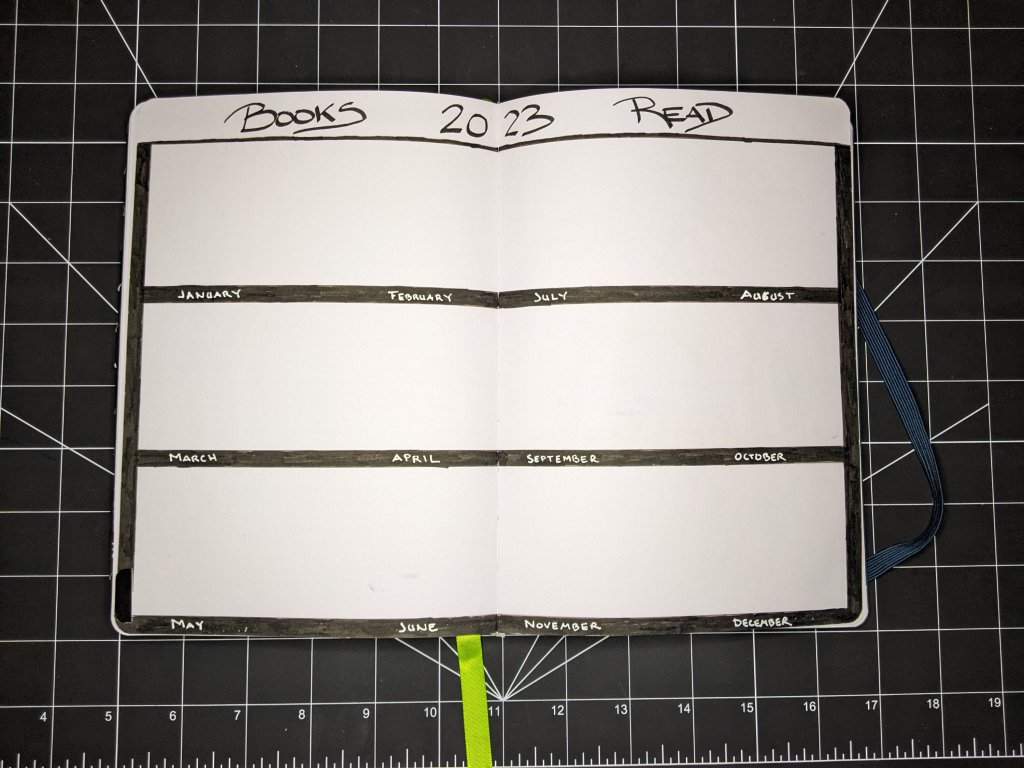
I made a bookcase where I can draw in and color code the books I read this year.

And I made a cover page with a key for the bookshelf color code. Opposite my cover page is the page I made to track the one goal I have for my reading this year. Can you guess what that goal is?

If you guessed “read or DNF/donate my backlog of Fairy Loot special edition hardcovers,” then you are correct!

As I mentioned in my 2022 wrap-up post, I did a terrible job reading physical books last year, even though I didn’t really travel anywhere, and I don’t have a commute. I seriously have no excuse. Well…except that I hate reading hardcovers in bed. Mostly because I don’t have (or want) a bedside reading lamp.

Since I don’t expect this year to be any different, I’m making some changes. My plan is to add one of these books to my TBR each month. I know there are only nine on that page, but I have ten, total. These are just the nine oldest, so they are the ones that I MUST get through this year. But I don’t necessarily have to finish all of them. DNFing is an option. If I read at least 25% of the book and am not sucked in, I will count that book as “done” and DNF/donate.

If I don’t complete (or DNF/donate) at least one of these each month, then I am going to suspend my subscription for a month. If I miss two months in a row, I’m going to cancel my subscription. I REALLY don’t want to do that because, even though it makes no sense whatsoever, I love special edition hardcovers. And the books that Fairy Loot picks are usually really good ones. So, I think the threat of cancelation is going to be enough to make this plan work.

It may also help that I just purchased a clip-on, rechargeable LED book light that I can use to read in bed. It’s not here yet (ordered online), but I’m hoping that helps as well.

So, is that really my only goal for this year?

Well…. Sort-of?

I have a stack of writing craft books I want to read for a project I’m working on. Plus I still want to read more books about social justice issues so I can expand my knowledge and awareness (target = 4 total). I’ve already identified several and added them to my TBR, but I’m on the lookout for a few more options in very specific areas.

I also want to continue to read books by diverse authors and with diverse main characters and from diverse publishing paths. I have some targets in mind that I’d like to hit, but I’ve been doing pretty well on that stuff organically. So I’m not going to focus on stats for those until mid-year. If I check in July, and I don’t like the look of my stats, then I may have to focus on that a bit more.

But the current priority is determining if there’s a place for special edition hardcovers in my life or not. So that’s my primary reading goal for 2023. Read in print. Specifically, the books I’ve already purchased.

I’m curious, do you also have a backlog of hardcovers from subscription boxes that you haven’t read but want to? Do you track how much you read in print vs. e-reader vs. audiobook? Does it matter to you? Are you trying to change any reading habits this year? Let me know in the comments.

July reading journal set-up

My July reading journal set up video is posted on YouTube! If you want the flip through, the video is linked below.

Because this is going up so late in the month, and I neglected to film the final July cover page and outbox spreads until today (!), I end up revealing the first two books I read this month at the end of the video. Just skip that part if you don’t want spoilers for my end of month wrap-up. But really, does anyone care about spoilers for a reading wrap up? I can’t imagine that’s an actual thing.

If you don’t want to watch the video or if you just want the non-spoiler version of my July cover page and don’t care about my Hugo nominee spread or the weird little TBR pockets I made, here’s a photo for you.

While I didn’t really mention any specific reading plans in the video, I did mention my plan to read the Hugo nominees for best novel and best novella. I also showed how I’m going to track and rank them. I just never said when I planned to read them.

I don’t plan to fill my entire TBR with Hugo nominees this month, but I do want to make a large dent in that reading list before August.

Roughly, these are my reading goals for July:

  • Don’t waste time on books that are bogging me down! If I feel like I *have* to finish them for some reason (like the Hugo nominees), then set a daily page count target and alternate with something fun and fast paced at the same time.
  • Finish reading Project Hail Mary and A Master of Djinn since I’ve already started reading both.
  • Read In An Absent Dream and Come Tumbling Down so I can get caught up on the Wayward Children novellas. (The one that comes after these is on my Hugo nominee for best novella reading list.)
  • Start working through the nominees for best novella, starting with the shortest one (Fireheart Tiger) and moving through them in order of shortest to longest (Across the Green Grass Fields).

It’s an ambitious reading plan, but I think I can work through the novellas pretty quickly, and I like quick wins.

If I can manage to check off all my goals this month, then I’ll only have two best novel nominees left to read in August. One of those is kind of intimidating, but it is the novel I think I will end up liking best of the bunch. The other is one I definitely expect is going to drag for me (given how I’ve felt about other books I’ve read by that author). So the more I can read this month, the better.

That said, the priority for the month is that first goal. I want to be immersed and enjoying what I’m reading as much as possible. The theme for the month is beach vibes after all!

What are your reading goals for July and/or the second half of this year?

Planning for a productive week

It’s the first Monday of June!

Did you know I love the start of a new month? I’m all about that monthly goal reset, and I’m always making tweaks to my productivity systems whenever I feel like I’ve stopped making forward progress.

I love my bullet journal for making lists and taking notes, but sometimes the bigger projects (like writing and editing a novel) get lost in the day to day grind. It’s way too easy for me to get distracted by crossing admin tasks off my list and forget about the big stuff. Especially when it’s just one bullet point among many.

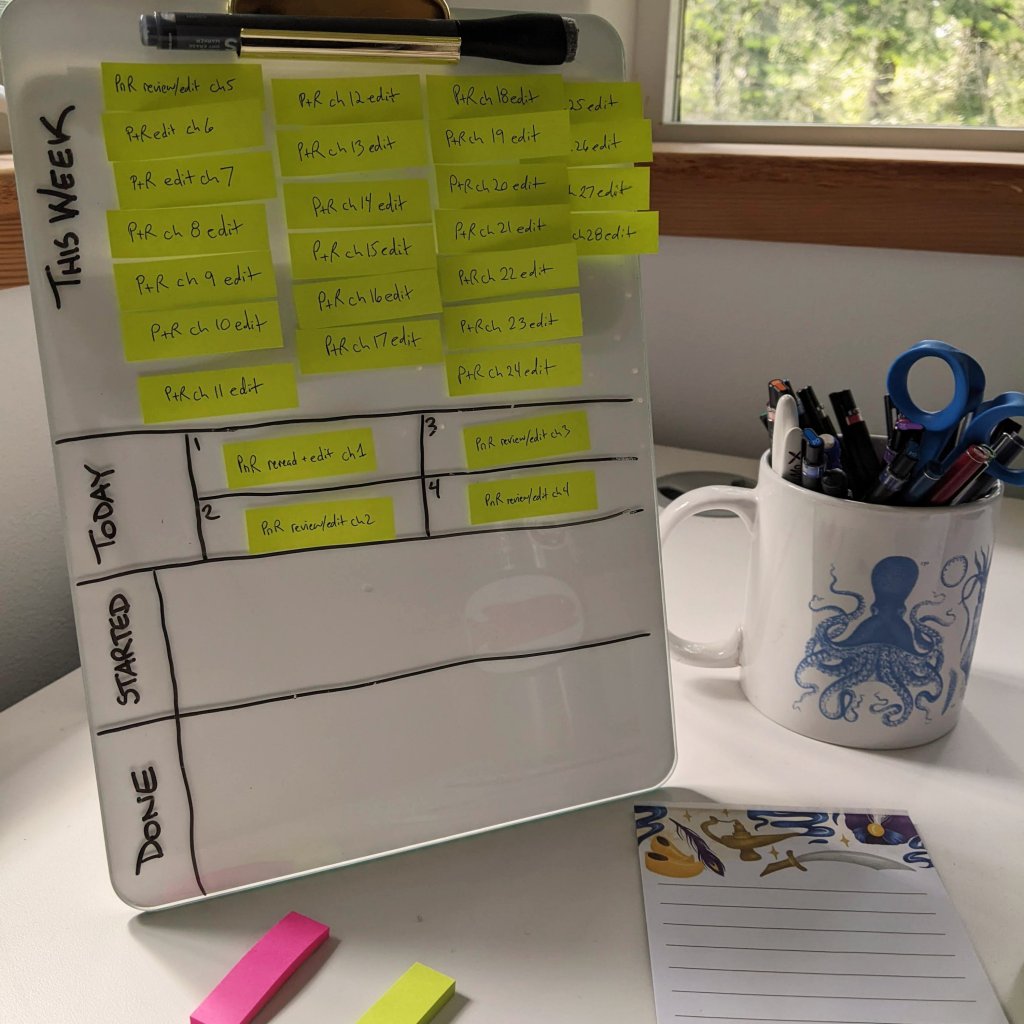
So I came up with the idea to use a little dry erase board on my desk to keep my project tasks top of mind.

Each week, I load it up with all the bite-size tasks that make up whatever project I’m trying to complete that week. Each task is meant to be something I think I can do in thirty minutes (aka, a “sprint”). Then, each morning, I pick four tasks to move to the “Today” section of the board. Once I start a task, I move it down to the “Started” section. And once it’s done, I move it to the “Done” section. At the end of the week I toss the “Done” tasks and reset the board for the new week. It’s very satisfying.

This week, I’ve set up my board with one task sticky for each chapter of Petals and Runes. The project goal for this week is to complete my read through and collect all my revision notes. Ideally, I’m going to focus on reading and making notes, not on actually revising.

I’m not really sure if it’s going to take me a full week to get through this, or not. Every book is different. Sometimes this process goes really fast. I suspect that, since I haven’t been back in this world for a while, this is going to be pretty slow. I think I’m going to have to stop frequently to make notes as I read.

Also, this isn’t the only thing I’m doing this week. In addition to this writing project, I have a lot of other publishing admin tasks to do related to the Ash of the Fae release on the 21st, plus my usual household stuff to do. I’m keeping track of all that stuff in the weekly spread in my bullet journal. So, I think allocating a whole week for this part of the revision process is a realistic estimate.

How about you? How are you keeping track of your to-do list this week?

June reading journal set-up

My June reading journal set-up is live!

Below is the link to the full video on YouTube…

In the video I mention the four books that are on my TBR for June. They are:

  • Engaging the Enemy by Elizabeth Moon — my current in-progress read
  • Intuitive Editing by Tiffany Yates Martin — a writing craft book to help me with my current project (which I promise I’ll talk more about in a future post)
  • A Dance With the Fae Prince by Elise Kova — my pick for International Fairy Day on 24 June
  • How to Find a Princess by Alyssa Cole — a book I’ve been wanting to read for a long time that keeps getting put off

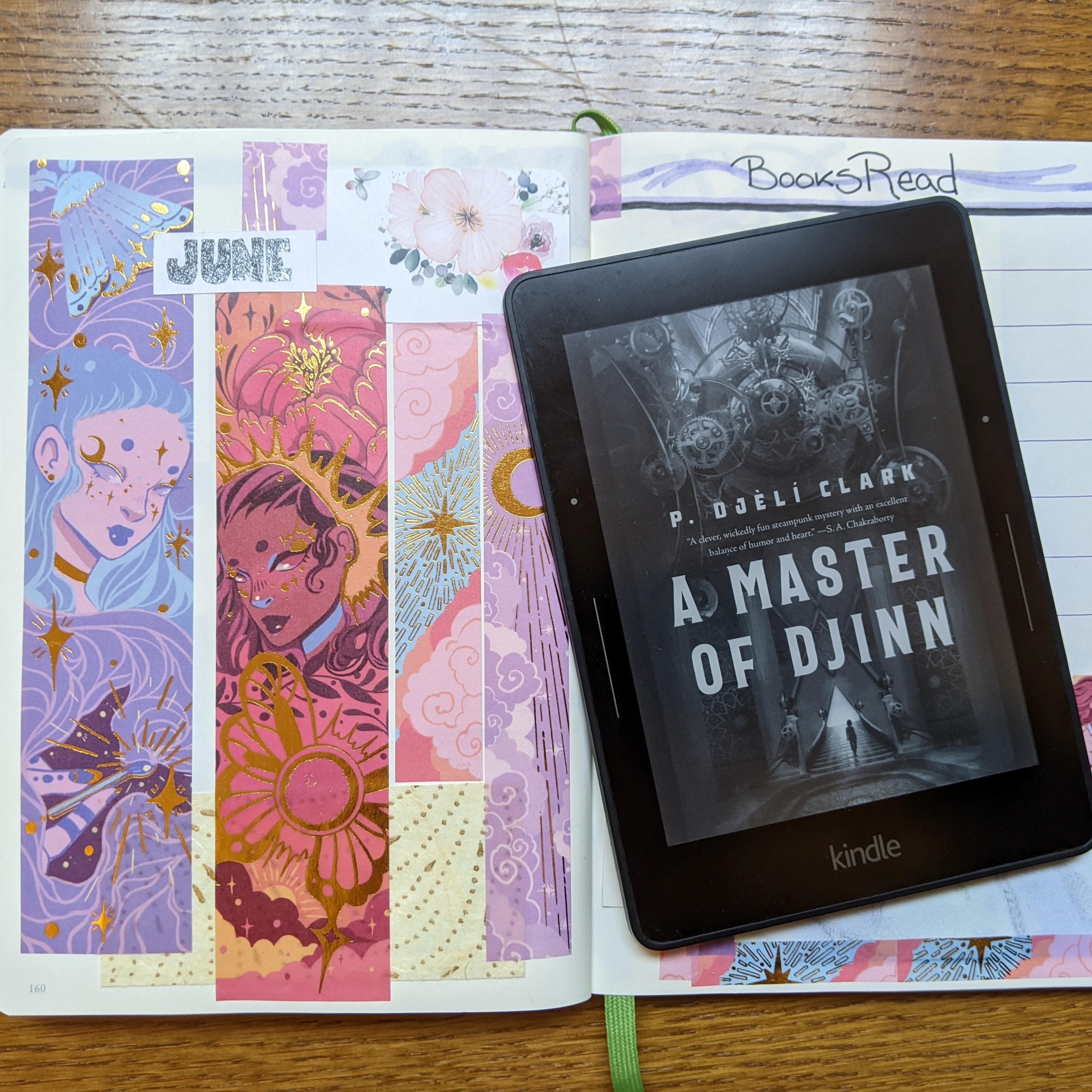
I also mentioned that there are a whole bunch more that are at the top of my TBR, I just didn’t have the covers printed out. So I didn’t add them to the pocket. One of those is the book that I’m planning to start this weekend: A Master of Djinn by P. Djèlí Clark.

The SFWA Nebula Conference was a couple weeks ago, and I was reminded again how much I’ve been looking forward to this book after reading the novella set in the same world (The Haunting of Tram Car 015). They’re basically mystery novels set in a sort of steampunk alternate Cairo. I really loved the novella and can’t wait to read the novel.

So that’s my plan. Now it’s your turn. What are you reading this weekend? What’s on your TBR for June?

March 2022 Reading Journal Set-Up

We’re already several days into the month of March, but don’t worry. I didn’t forget about posting my reading journal spread. This post just took a bit longer than usual to write. You’ll see why in a bit.

I have been messing around with my friend’s Canvas lamp. (Side note: She’s awesome and you should go check out her art!). I saw an ad for the Canvas lamp (which is like a ring light that has a phone holder and clamps to your desk), and I was considering buying one when I found out that Zoe had recently received one as a gift. So she’s letting me test it out while she’s busy with other stuff. I have mixed feelings about it so far. I think I can take better photos without the lamp (the one above was taken with the lamp, then “enhanced” a bit on my phone before uploading). So if that’s all I am going to do with it, I can buy a cheaper desk lamp for my office. But…

I did play around with making a video flip-through of my reading journal set-up. You can check that out below.

It’s a little rough, but I don’t think that’s the lamp’s fault. 🙂

I think I need more practice if I’m going to make more videos like this. But I’m willing to give it a few more tries. If you want me to make more set-up and/or flip-thru videos, please let me know by liking my video on YT, and/or subscribing to my channel, and/or just leaving a comment over there or on this post. If there’s enough interest, I’ll do a March wrap-up flip through and a set-up video for April where I actually film the me-doing-art part.

If you watch the video, you’ll get to hear me talking about my plans for the Mini-Magical Readathon in March. I made a few spreads to help me keep track of my reading prompts and options. I have to read a minimum of two books. One to earn my magical conduit and another to determine my legacy. I’m putting off picking books to go with the prompts until closer to the start of the event (14 March).

In addition to participating in the Mini-Magical Readathon, I have a few other reading goals for this month. I didn’t make specific pages for these in my reading journal. I am just sharing them here for accountability, and so I can remember to report back on how I did when I do my wrap-up post at the end of the month.

  • Aggressively DNF! — I really need to stop feeling guilty about not finishing books that just aren’t clicking with me. Usually, it’s not the book’s fault, which makes it even harder to just put it down and pick up something else. The problem is, if I’m forcing myself to read a book that I’m not clicking with, it takes me at least 2x as long to read it, and I risk putting myself in a slump. So, this month I’m going to be aggressive about DNFing anything that I’m not enjoying. If it’s not a “hell, yes!” then I’m setting it aside and saying “maybe later.”
  • Read at least one non-fiction book — I have a stack of non-fiction that I want to get through this year. The trick is going to be picking one that doesn’t violate my “aggressively DNF” goals.
  • Read at least 60 pages of one book from my physical TBR (then finish or DNF/donate) — This goes nicely with my “aggressively DNF” goal. I set myself a sixty page evaluation point because most of the books in my physical TBR stack are around 300 pages, and if I’m not into a book by the ~20% mark, then it’s probably not happening. I don’t need to horde books that I’m not interested in reading anymore, especially ones I got from subscription boxes. So, the goal is to pick one, read 60 pages, and decide if I want to keep going. If yes, I’ll try to finish it before the end of the month. If no, I’ll donate it, pick another, and repeat until I find something that sticks.

So that’s what I have planned for March. What are your reading plans? Are you participating in the Mini-Magical Readathon? If so, which guild did you get sorted into? Any fellow Mind Walkers out there?

Setting up my reading journal for the New Year

We’ve been having a week of cold and stormy weather where I live. So I’ve been home, hanging out by the fire, and working on setting up my reading journal for 2022.

Despite my ongoing love/hate relationship with my reading journal, I’ve decided to continue using it next year. Some of that decision has to do with the fact that I’ve only filled half the pages in this notebook. But also, I am starting to prefer tracking my reading in my journal to tracking it on Goodreads. Plus, I think I’ve finally figured out how I want to use it to track notes about the books I’ve read.

So, keep scrolling if you want to see how I’ve set things up for 2022 and what I’ve kept and changed from last year’s set up.

2022 Reading cover page with a stack of books

I don’t like the placement of that quill and ink bottle sticker on my cover page, but other than that I’m pretty happy with how it turned out. Like this year, the Tombow marker color I used for the genre is marked on the book spine, and I’ll be using this color coding when I draw in books on the book case in the following spread.

Books Read in 2022 with three empty bookshelves

I liked the year overview bookshelf that I did this year, so I decided to do it again. I only made a few changes. The stripes of black that serve as the base of the shelves are a bit wider this time, and I wrote the month under where I’m going to draw in the books instead of above. Also, I figured out that one of the rectangles on the ruler / stencil combo that I have is the perfect size to use as a book spine. I doodled some in on the May / June shelf just to test it out, and then I added a sticker for decoration.

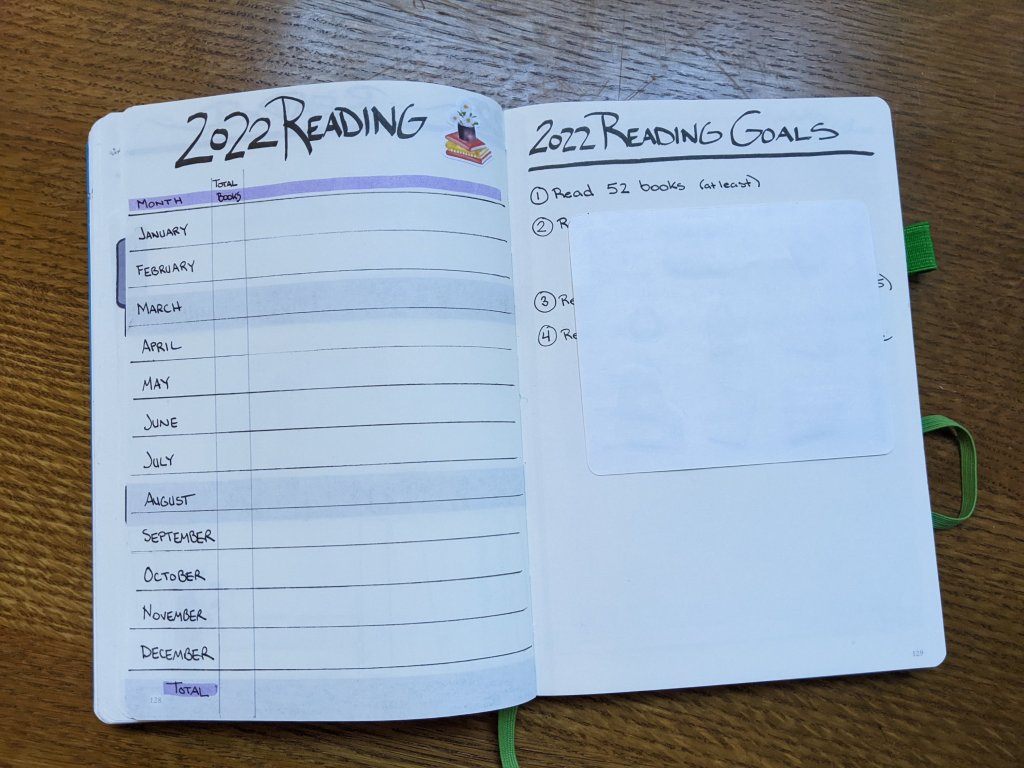
2022 Reading Stats table with one line per month to fill in total books read and other relevant stats about my reading, and list of 2022 Reading Goals.

I haven’t quite finished this spread, yet. I’m still working on what data I actually want to keep track of (aside from number of books read). This year I kept track of things like book format, age category, and books written by BIPOC and/or LGBTQIA+ authors. I will probably do something similar in 2022, but I’m going to wait until I have my reading goals sorted out before I draw in any more columns. For example, what’s the point of tracking what format I read in (ebook vs. print vs. audio) or where the book comes from (owned vs. library vs. gift) if I don’t have a reading goal associated with that data? I mean, it’s interesting information. But maybe I can just make a note of that on the page of book notes and not track it here? I don’t know.

2022 Read Harder Challenge from Book Riot printed out and pasted into my journal

I’ve always enjoyed Book Riot’s Read Harder Challenge. I’ve participated on and off every year since the first one. But in 2021 I pretty much ignored the challenge completely. I put the prompts into my reading journal at the start of the year, just in case I changed my mind part way through and decided I wanted to participate. But I’m pretty sure I didn’t do any of them, even accidentally.

I’m putting the prompts in again for 2022, but this time, after looking over the prompts, I think I may end up participating at least a little bit. And maybe on purpose? We’ll see. I do think it’s a great list of prompts if you’re looking to diversify your reading (which is always one of my reading goals).

I love all the read a genre book by a BIPOC and/or LQBTQIA+ prompts, especially the “read a book in any genre by a POC that’s about joy and not trauma” prompt. Possibly my favorite of the prompts for 2022 is “read a romance where at least one of the protagonists is over 40.” My least favorite of the prompts is definitely “read an award-winning book from the year you were born,” because I think it’s going to be very hard for me to find a book I’m excited about reading that fits that prompt.

Aside from casual participation in the Read Harder Challenge, I don’t plan on doing any other official reading challenges, and I am not making a “22 books to read in 2022” list because that was an utter fail this year. I think I read maybe three of the books I put on that list?

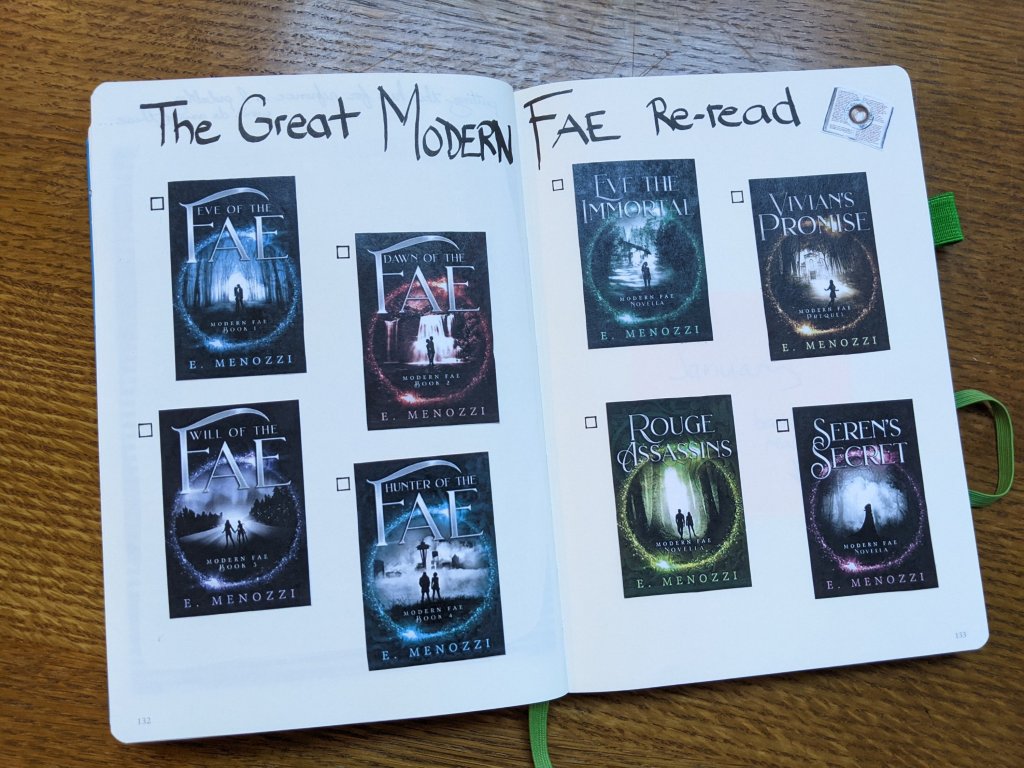
I do have a couple of reading projects that I’ve set for myself. The first is a re-read of all the novels and novellas that I’ve published to date in my Modern Fae series. I want to complete this in January, if possible, before I dive into developmental edits on book five. So I made this spread to track my reading progress.

The Great Modern Fae Re-Read with cover images of the four novels and four novellas published to date and a check box next to each.

I also have a selection of writing books and a short list of non-fiction books on anti-racist and social justice topics that I want to read in 2022. Those are going to be incorporated into my goals, I think. I may also make a spread to track them. Other than that, I’m going to continue to resist the urge to make TBRs in 2022. Instead, I’m going to try to follow my reading whims where they lead.

I have one more book (maybe two?) that I want to try to finish before the end of 2021. Then I can do my December wrap-up and my 2021 reading stats posts. I also need to set up my cover page for January, once I decide what sort of cover image I want. And finish my 2022 reading goals. So stay tuned for more reading journal posts, coming soon.

And if you want to join in my Modern Fae re-read, I’m starting with Eve of the Fae on the first of January, and I’ll be posting progress over on Instagram.

In the meantime, do you have a reading journal or are you starting one for 2022? Are you setting any reading goals for 2022? Are you participating in any challenges or setting any reading projects for yourself? Let me know in the comments.

Writing Process Insights From NaNoWriMo

We’re just about halfway through December, and I am still working on finishing up the first draft of the novel I was working on for NaNoWriMo. I’m down to the final two chapters, and I’m dragging my feet about finishing them. Seemed like a good time to recap what I learned from this year’s NaNoWriMo.

I’m breaking this post into three parts. Part one includes the new things I tried to incorporate into my writing process in November that worked better than I thought they would. Part two is the stuff that did not work as well as I thought it would. And part three are the things I have carried over into December.

Things I tried this month that worked better than I expected

  • At least one sprint “first thing” in the morning — This was possibly the one thing that worked best for me and made me the most productive. By “first thing” I don’t mean that I got up at 5am to write. I’m not naturally a morning writer, and the 5am writers’ club has never really worked for me, even when I worked full time. I can exercise early in the morning, but it takes a while for my brain to wake up. This month, I decided to let myself wake up at a normal time for me. I ate my breakfast and drank my tea like I usually do. But instead of letting the morning get away from me, I tried to get into my office to write at least one sprint by 9am. I didn’t always succeed, but the days that I did, it was so much better. At some point, I realized that the longer I wait to write during the day the harder it is for me to sit my butt down and get it done. The resistance builds to the point where I start to think “meh, I’ll just do more tomorrow.” But if I write for even just thirty minutes right after breakfast, even if I ignore my project for the rest of the day, it’s so much easier to go back to it in the evening and finish my sprints. I have no idea why this works, but it does, and it’s become my new thing.
  • Alarm on my phone — I set an alarm for weekdays at 9am to remind me to get my butt out to my office and get to work. This allowed me to relax a bit more while I ate breakfast, checked my email, read, or listened to a podcast. I knew I could rely on my alarm to remind me to get to work (more so than a calendar reminder, which did NOT work).
  • Reprioritizing my “to-do” list — This goes along with writing “first thing” in the morning. Normally, I have all these little tasks that fill up my to-do list that I think are only going to take a few minutes and end up taking an hour or more. Since I like the satisfaction of checking things off my list, I do them first, even though I know I shouldn’t. Giving myself permission to basically ignore all that until December (or at least until I got my writing done for the day) was magic. All of a sudden I was doing what was important to me first instead of doing a bunch of admin stuff that was not time sensitive. And, I still got the satisfaction of checking things off my list because of the next two items.
  • Sprint log — I have never used one of these before, and I wasn’t sure I wanted to use it, but I thought I’d give it a try. It turns out that I found it super motivating to have a place to jot down my word count after each sprint! I don’t even care what the number was. Just the act of being able to write it down (and color in the box on my sprint summary log), gave me that boost of “yay! I did a thing! Let’s do it again!”
  • Word count progress chart — When I set this up, I thought maybe this was overkill, but I ended up really liking the visual progress tracker aspect of being able to color in boxes for each 1k words written. The stuff in the middle was a little redundant and unnecessary, but the progress chart was really helpful.
  • Limiting social media and other online distractions — I do this by using the digital health controls on my phone and allowing myself only five minutes (each) on Instagram and Twitter. Those are the only two social apps on my phone. I don’t log into any social apps on the computer in my office. Limiting the amount of time I could spend on an app made it so that I knew I could check it whenever, but I couldn’t get lost in the infinite scroll. Once my five minutes were up, they were gone for the day and it was time to get to work.

Things I tried that didn’t really work for me

  • Scheduling time to write on Google calendar — I thought this was going to help, but I didn’t even look at these time blocks once during the month. This method of time management just does not work for me.
  • Having consistent rules about what distractions were allowed and when they were allowed — I had this idea that I was going to outlaw all social media and gaming until after my writing was done for the day. That didn’t really work. I found that I was much more productive when I allowed myself to play some MtG Arena, or watch a YouTube video (or three), or even watch a full episode of a serial between writing sprints. Sure it delayed how long it took me to get my writing done for the day, but it also made it so that I never really felt like my creative well was going dry. This refueling became especially important on some of those days leading up to 50k when I only had to do two thirty minute writing sprints, but I was already pretty drained from writing so much in such a short amount of time. Honestly, this is the least burnt out I’ve felt after a NaNoWriMo, and I think that flexing this rule is why.
  • Crockpot meals — This one surprised me. I love crockpot meals. But unless the recipe was just “dump these four ingredients into the crockpot and turn it on,” preparing a crockpot meal used up valuable morning hours just to free up less valuable pre-dinner hours. Since getting out to my office and getting at least one sprint in turned out to be the most important thing I needed to do each day in order to get my writing done, I realized it was a lot easier to pick recipes that allowed me to do all the cooking in the evening.
  • Any cooking that required a lot of steps or prep — This one I underestimated. I thought it wouldn’t be a big deal, but we have this one recipe that we eat all the time, and it’s pretty easy to prepare, but it involves a LOT of vegetable prep time. I had already purchased the veggies and they were going to rot if I didn’t use them, so I went ahead with my meal plan. But, after that first week, I decided that this recipe is not for NaNoWriMo, or at least not for days when I need to get a LOT of writing done.

What I’m doing for December (since I’m still finishing this draft)

I’m still using my spreadsheet to manage and tweak my daily word count goals, but I’ve combined what I think were the most useful and motivating parts of my various trackers into one layout. I’ve got the progress bar on the outside like last time, but this time I moved the daily word count and sprint tracker to the inside. The calendar is a Midori blank calendar sticker. The little unicorn sticker is from Procrastiplanner. The little arrows were supposed to mark reward milestones, but I decided not to do rewards this month. Each day, I’m putting my daily word count above the little line in the calendar box, and putting stars for sprints below the line. One star is equal to one sprint, or thirty minutes of writing.

I’m still using the sprint log to jot down when I’m writing and how many words I wrote in my thirty minute sprints. It’s become a bit less important now that I’m really only trying to get two sprints in per day instead of three or more like I was doing during NaNoWriMo. For that reason, I’m not sure if I’ll keep using this outside of periods like NaNoWriMo where I’m making a focused push to fast draft a first draft.

As you can see from the picture, I’ve changed quite a bit of the pre-printed tracker from Sarra Cannon’s NaNoWriMo Prep workbook. I’ve adapted it to fit better with what I actually want to track. Specifically, what time did I start the sprint, how many words did I write, and what’s my new total word count. If I decide to use a sprint tracker again, I’ll probably just make my own and either draw it directly into my notebook or make something that will fit the page better when I paste it in. That way I don’t have to keep cutting out headers and Frankensteining together the cut up bits of the original tracker.

I have big writing plans for next year that include a lot more fast drafting, but I’ll talk about that more when I do a post on 2022 goals. So we’ll see how much of this new process stuff sticks in the New Year. In the meantime, let me know in the comments how your NaNoWriMo went. Did you learn anything new about what does and doesn’t work for your writing process?