Planner System Update

It’s that time of year again! Everyone in the planner community is eyeing the 2025 planners and making their decisions about what is going to give them “planner peace” in the new year.

As for me, I think “planner peace” is like the Easter Bunny or Santa. Doesn’t exist. And that phrase is beginning to make my ass twitch.

Why am I so grumpy about planners, you ask?

If you have been reading this blog for a while, you can probably guess. You might remember my previous posts on my various misguided attempts to find the perfect (for me) planner to replace my bullet journal, and you’ve likely been expecting this post.

To catch you up if you haven’t been following along on this adventure… I first tried the Bullet Journal method back in summer of 2017. Then, during then pandemic when “planning” sort of seemed like a sick joke, I decided to try moving from a BuJo to dated planner (Passion Planner monthly). I don’t think I made it through even half of 2021 before I bailed and went back to the BuJo method.

I tried again in 2022 with a slightly different dated planner system (Midori monthly). That also didn’t work out. Then I made another attempt in 2023 with yet a different planner set up (Passion Planner weekly). Another fail by mid-year that had me trying the Hobonichi Techo half-year planner instead. I was convinced it was going to work because it had monthly, weekly, AND daily planner pages, which seemed to be what I was missing in my previous attempts to replace my BuJo.

And I was right. Mostly. That set-up worked well enough that I convinced myself to try the full year Hobonichi in 2024.

This year’s planner: a Hobonichi Techo 2024

However… there aren’t a lot of blank pages available in that planner for goal planning or what the BuJo folks call “collections” (ex: project task lists, notes, etc.). And, because I wanted to have a dedicated place to track my running, I got a running journal as well.

Running journal

In addition to those, I have a separate notebook for journaling, plus another for each of my writing projects.

The current in-progress notebook stack

It’s too much, and it’s making me want to return to my bullet journal. I was doing my best to hold off until January before making a change, but this past week I decided to give up and go back to the BuJo, at least for the rest of September.

The notebook I was using for my bullet journal before I switched to the dated planner still has about a hundred blank pages left. I think it’s nearly enough to get me through the rest of this year. So, I’m going to see if I can even remember how to BuJo, and see if it’s just the entire concept of planners that has been frustrated, or if I finally can find some “peace” by going back to the BuJo Method.

Expect an update sometime in December, when I commit to a 2025 planning system…

Tweaking My Planner System (Again)

Most of today was spent making progress on cleaning up the novel I’m working on, but I did spend a little time thinking about my 2024 planning system. In a previous post, I mentioned that I’ve switched from using a bullet journal to trying out the half-year Hobonichi Cousin. It’s been working well. Mostly. But there have been a few things I’m not entirely pleased with.

The first of those is that the Cousin doesn’t have a lot of blank pages for free-form planning and notes. So, if you want to do that, you’re limited to using the daily pages, or looking elsewhere. The more I tried to stay in the planner and work around this, the more frustrating it was to keep track of progress toward my quarterly and monthly goals. Eventually, I tried using Obsidian to fill in the gaps.

After months of trying to keep track of tasks across multiple notes in Obsidian and struggling to find a view that worked for me, I gave up. About a week ago, I started pulling all the tasks I’d created out of my Obsidian notes and moving them to my planner. The only problem was, I still had no place to put my goal and project planning. I think this is why some people end up using multiple planners. But I am determined to figure out how to make everything work in one.

The solution I’ve come up with is one that I’ve found by watching planning videos from other Cousin users on YouTube. That’s how I figured out that you can buy a thin companion notebook that has only about forty sheets in it. These notebooks are meant to slip into the back cover of your planner. Awesome! Problem solved!

Except, I live on a tiny island. I’d need to order these online, because there are no stores here that sell that sort of thing. And there is no way (given the absolutely slammed holiday mail situation on said tiny island) that these would arrive anytime soon. Best case, they’d likely be here a few days before the New Year.

Not to worry. I have a perfectly good bullet journal that I only used for three months. There is still at least half a notebook worth of blank pages in there. So, new plan! I am going to use my old bullet journal for noodling out 2024 goal and project planning. Once I have everything figured out, I’m going to copy it over onto one of the precious few blank pages in my Hobonichi Cousin.

Here’s how it’s going to work: There are exactly four blank pages in the planner. I’m going to use one for each quarter’s goals. Then I’m going to use the blank page at the start of each batch of monthly pages as a place to track all my monthly projects and task. This will be kind of like the right-hand side of the monthly spreads I used to do in my bullet journal.

I also have the start of a plan for how I am going to track my reading in the planner. I don’t have a good spot for doing any readathon spreads, though. But I have some ideas about how I want to handle that, and I have time to figure it out. I think the next Magical Readathon isn’t until April.

I’m going to keep using Obsidian. Overall, I like it. I think it works best for things like you would put into a “collection” in a bullet journal. So, lists of movies I want to watch or books I want to read, research and links for vacation planning, notes on what I want to remember to fix in my next edit pass on my book, a brainstormed list of tasks for a project, that type of thing. This is a great addition to my system because it’s digital and searchable and syncs across all my devices (you can’t hyperlink in a notebook). Plus, I definitely do NOT have a place (other than the daily pages) for that sort of thing in the Cousin.

Ultimately, I envision the Obsidian-Cousin flow looking something like this: Notes in Obsidian will generate tasks and/or projects. Those will get migrated to my planner so I can keep track of them. Meanwhile, my daily pages in my planner will probably generate content that needs to be migrated to a note in Obsidian. Either an existing note (for example, a new task to add to a project note), or a new note (like a place to park a new story idea so I can add to it later).

I have to say, it’s a relief to have a plan. When I feel like I have things I need to keep track of and no place to put them, they just fester in my brain, taking up space and keeping me from doing other, more creative things. Now that I’ve been able to off-load some of that junk, knowing I have a system in place so I don’t just forget about it, I feel a bit better.

Next up is taking some time to sort out my goals and projects for next year. But, I’m trying to hold off on doing that until next week. After this draft of my novel is done.

I’m planning a series of posts at the end of the month where I’ll talk more about how I did on my 2023 goals and what some of my goals are for 2024. When I do those, I’ll take some photos of my planner spreads to make it easier to see what I’m doing.

Planning for a productive week

It’s the first Monday of June!

Did you know I love the start of a new month? I’m all about that monthly goal reset, and I’m always making tweaks to my productivity systems whenever I feel like I’ve stopped making forward progress.

I love my bullet journal for making lists and taking notes, but sometimes the bigger projects (like writing and editing a novel) get lost in the day to day grind. It’s way too easy for me to get distracted by crossing admin tasks off my list and forget about the big stuff. Especially when it’s just one bullet point among many.

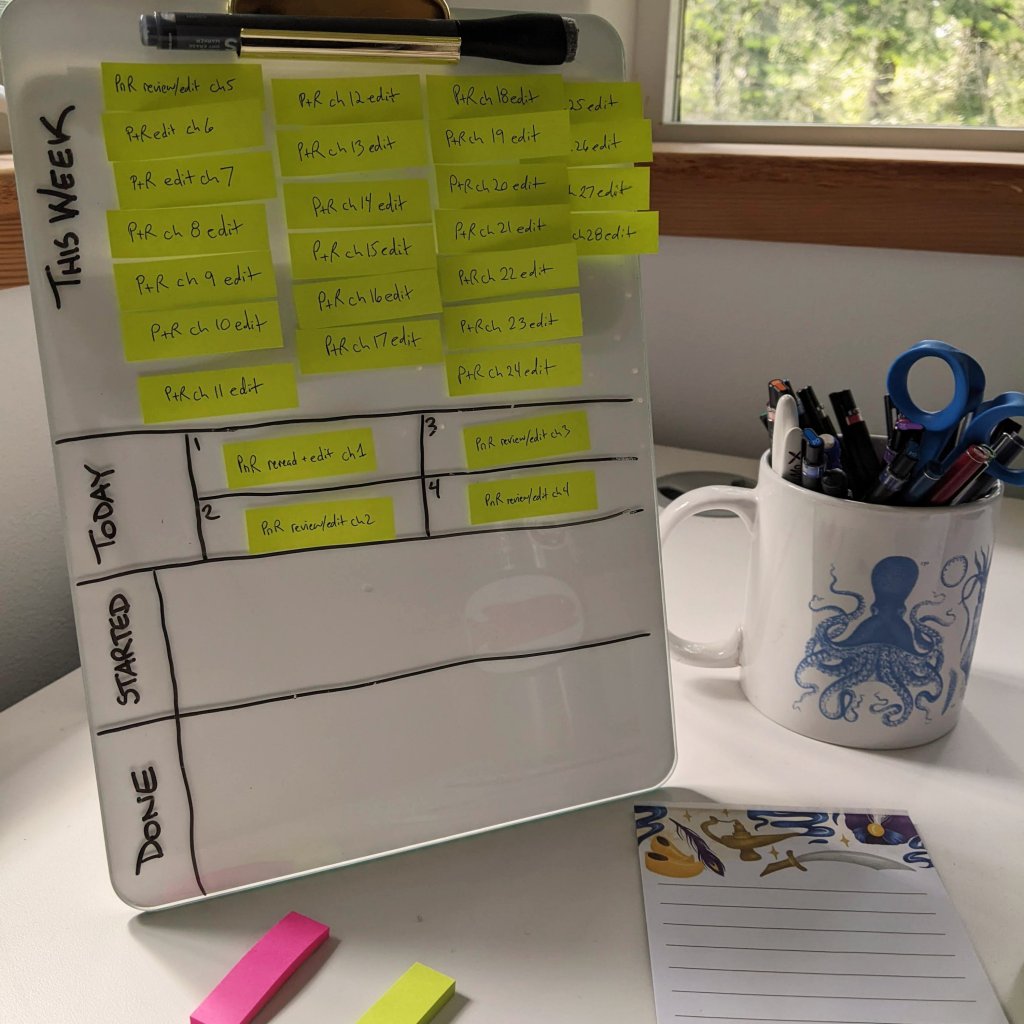
So I came up with the idea to use a little dry erase board on my desk to keep my project tasks top of mind.

Each week, I load it up with all the bite-size tasks that make up whatever project I’m trying to complete that week. Each task is meant to be something I think I can do in thirty minutes (aka, a “sprint”). Then, each morning, I pick four tasks to move to the “Today” section of the board. Once I start a task, I move it down to the “Started” section. And once it’s done, I move it to the “Done” section. At the end of the week I toss the “Done” tasks and reset the board for the new week. It’s very satisfying.

This week, I’ve set up my board with one task sticky for each chapter of Petals and Runes. The project goal for this week is to complete my read through and collect all my revision notes. Ideally, I’m going to focus on reading and making notes, not on actually revising.

I’m not really sure if it’s going to take me a full week to get through this, or not. Every book is different. Sometimes this process goes really fast. I suspect that, since I haven’t been back in this world for a while, this is going to be pretty slow. I think I’m going to have to stop frequently to make notes as I read.

Also, this isn’t the only thing I’m doing this week. In addition to this writing project, I have a lot of other publishing admin tasks to do related to the Ash of the Fae release on the 21st, plus my usual household stuff to do. I’m keeping track of all that stuff in the weekly spread in my bullet journal. So, I think allocating a whole week for this part of the revision process is a realistic estimate.

How about you? How are you keeping track of your to-do list this week?

NaNoWriMo Prep: Manage Your Time

What’s this? A second week dedicated to planning? Sounds right to me. After all, half the battle is finding the time to get the words on the page. Even when you are absolutely not in the mood to write. Probably especially then.

As a reminder, the schedule for NaNoWriMo prep is as follows:

  1. Develop a Story Idea (September 12-18) — Click Here to Read This Post
  2. Create Complex Characters (September 19-25) — Click Here to Read This Post
  3. Construct a Detailed Plot or Outline (September 26 – October 2) — Click Here to Read This Post
  4. Build a Strong World (October 3-7) — Click Here to Read This Post
  5. Organize Your Life for Writing! (October 10-16) — Click Here to Read This Post
  6. Find and Manage Your Time (October 18-24) <— You Are Here

Last week I talked a little about how I try to identify all the tasks and projects that might distract or derail me from my writing. Once I’ve rescheduled, canceled, or delegated everything that I possibly can, it’s time to sit down with my calendar and figure out when exactly I’m going to get my writing done.

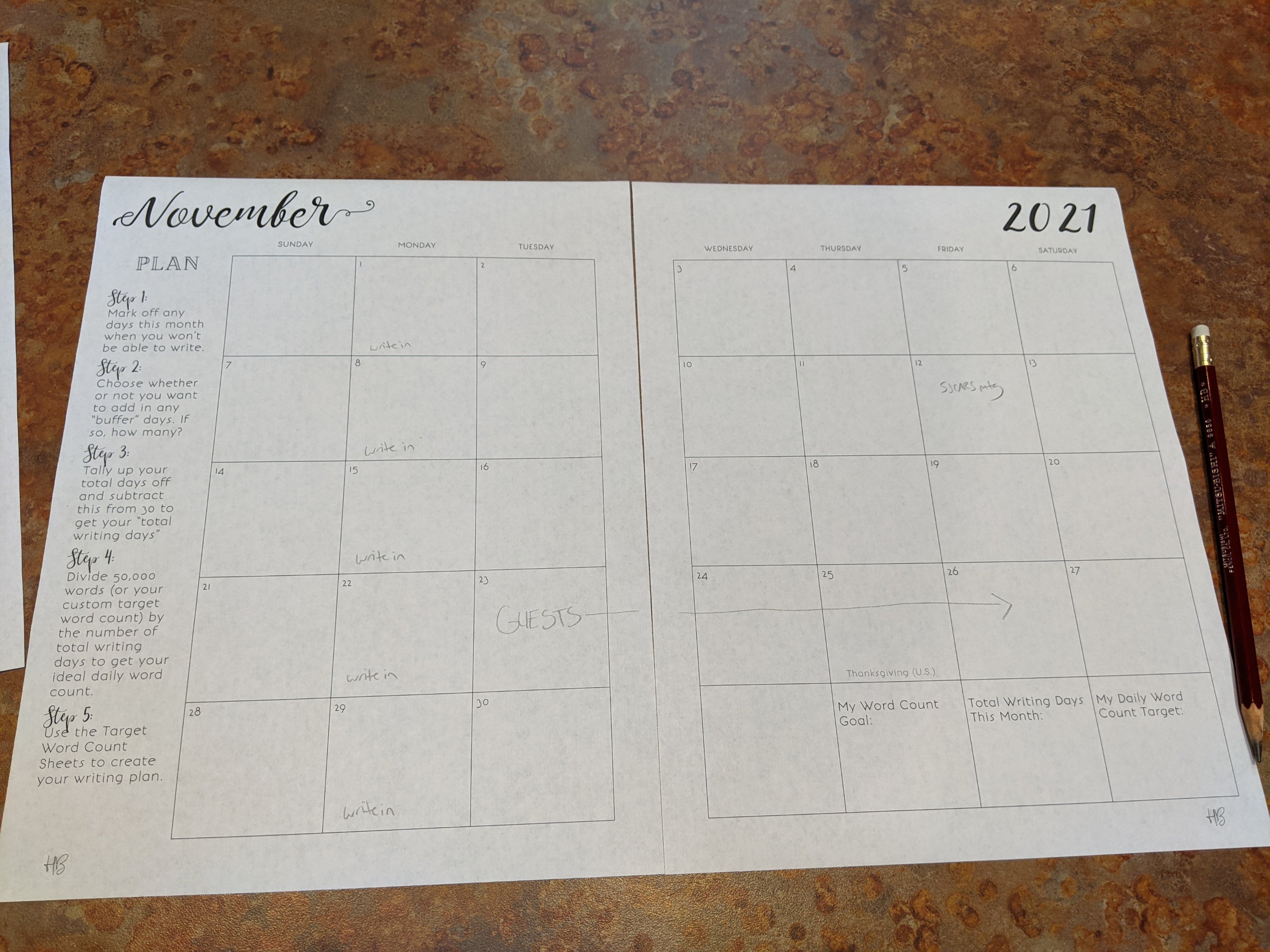
For the first part of this exercise, I used a printout of the calendar from Sarra Cannon’s Preptober workbook to create an overview of the month. This way, I can quickly see which days it is going to be challenging to find time to write, and which days I may be able to squeeze in some extra writing time.

In general, I’m adding only the big, out of the ordinary events to this calendar. I’m assuming that, unless otherwise noted, I just have my usual daily schedule to work around. The first thing I add are my conflicts, anything I couldn’t cancel or reschedule when I was organizing my time for November. Then I add my write-ins. Those may end up being my only dedicated writing time for the day (if it’s an already busy day), or they could represent possible extra writing time, if I also have time to fit in my usual writing sprints on my own.

Once I finish my calendar overview, I transfer those notes over to my word count spreadsheet. You can see a sample of what that looks like here and make a copy of the sheet for yourself to use, if you like. In the sample, I added my write-ins over in the “notes” column in green, and I added conflicts like Thanksgiving in red. On my actual spreadsheet there are more items, but the sample gives you an idea of what I’m doing.

Next, it’s time to do some math and figure out my daily word count goal. But first, let’s pause to talk about word count goals for a minute. Word count is not always the best measure of progress on a project, and it can be really demotivating to hear how many words others can write in a day when you are struggling to even get any writing done. However, when your goal is to “banish the inner editor” and get words (ideas) onto the page so that you can finish the whole draft before going back to make everything better, I think word count is a pretty good metric.

But if you find watching your word count to be completely demotivating, then time working on a project can be a good alternative. Pages or chapters written is another method. Marking milestones by acts or other major plot beats can be a good option. I use and like all these. The key is that you have a good idea of what conversion rate to use (words per page on average, words per hour on average, etc.) so that you have some idea if you’re on track to hitting your goal.

I’m using word count for my daily NaNoWriMo goal, but I’m also doing a conversion on that daily goal so I can estimate how many hours I need to set aside for writing each day. This is where the spreadsheet (or a calculator) really comes in handy.

There are two main strategies for establishing your NaNoWriMo daily word count goal. The first is what I like to call the “peanut butter” method, where you take the word count goal and divide by the total number of writing days to come up with a daily average that you spread evenly across the month (like peanut butter on bread, assuming you’re not allergic to either of those things). This is the traditional 1667 words per day NaNoWriMo target.

The other method tries to capitalize on the fact that you have the most motivation at the start of the month (and probably also the least number of schedule conflicts, if you celebrate the U.S. holiday of Thanksgiving). This method is called “reverse NaNoWriMo.” I didn’t invent it, but I think it’s brilliant. Since I stumbled across it on the internet, it’s been what I try to do most years when I participate in NaNoWriMo.

You’ll find both the traditional “peanut butter” method and the “reverse NaNoWriMo” method in my spreadsheet. I’ve also added a third set of columns which is what I use when I customize my word count goal for each day. I use the custom column to adjust my daily goal for the days where I have conflicts that are going to restrict my writing time. That’s why I put all those events in the “notes” column.

Because of how my schedule is shaping up this year, I am planning on starting with the “reverse NaNoWriMo” word count goals to capitalize on that early motivation. Then when my holiday guests arrive, I’m planning on shifting down to a word count goal that is more like what I can reliably write in one thirty minute sprint. This is where that conversation rate stuff comes in handy.

It’s all well and good to know how many words you want to write in a day. But how long is it going to take you to write those words, on average? My conversion rate is based on how many words I can usually write in one thirty minute sprint. For me, that is somewhere between 300 and 500 words. So I like to use 400 as an average word count estimate for one sprint. There’s a spot in my spreadsheet where I plug in my average words per sprint, and it will calculate how many sprints I need each day to hit that day’s word count goal.

Let’s take the first day of November as an example because that’s the day when I am scheduled to write the most words (my goal = 3335 words). My spreadsheet says that is going to take me about 8.3 sprints (or just over 4 hours). I know I have a write-in that evening, and we usually get in about two and a half sprints during that write-in. That leaves another 6 sprints (3 hours of writing, not counting breaks) I need to find time for earlier in the day. If I can’t find time in my schedule, then I need to adjust my word count target to something more realistic.

This year, I’m actually scheduling writing sprint blocks on my Google calendar so that I know how many hours I need to be writing each day in order to hit that day’s word count goal. Normally, I don’t bother to block out chunks of writing time. I just keep track of my word count goal and squeeze in writing time between other activities after doing a lot of procrastinating. You can guess how well that works.

I’ll probably end up moving those writing blocks around as needed, but I think that having the one or two hour blocks of time sitting there on my schedule will be a good reminder that, even if I put off writing, I’m still going to need at least an hour to write 1000 words. So, it’s probably better to get it done early because I’m not going to find more time in the day.

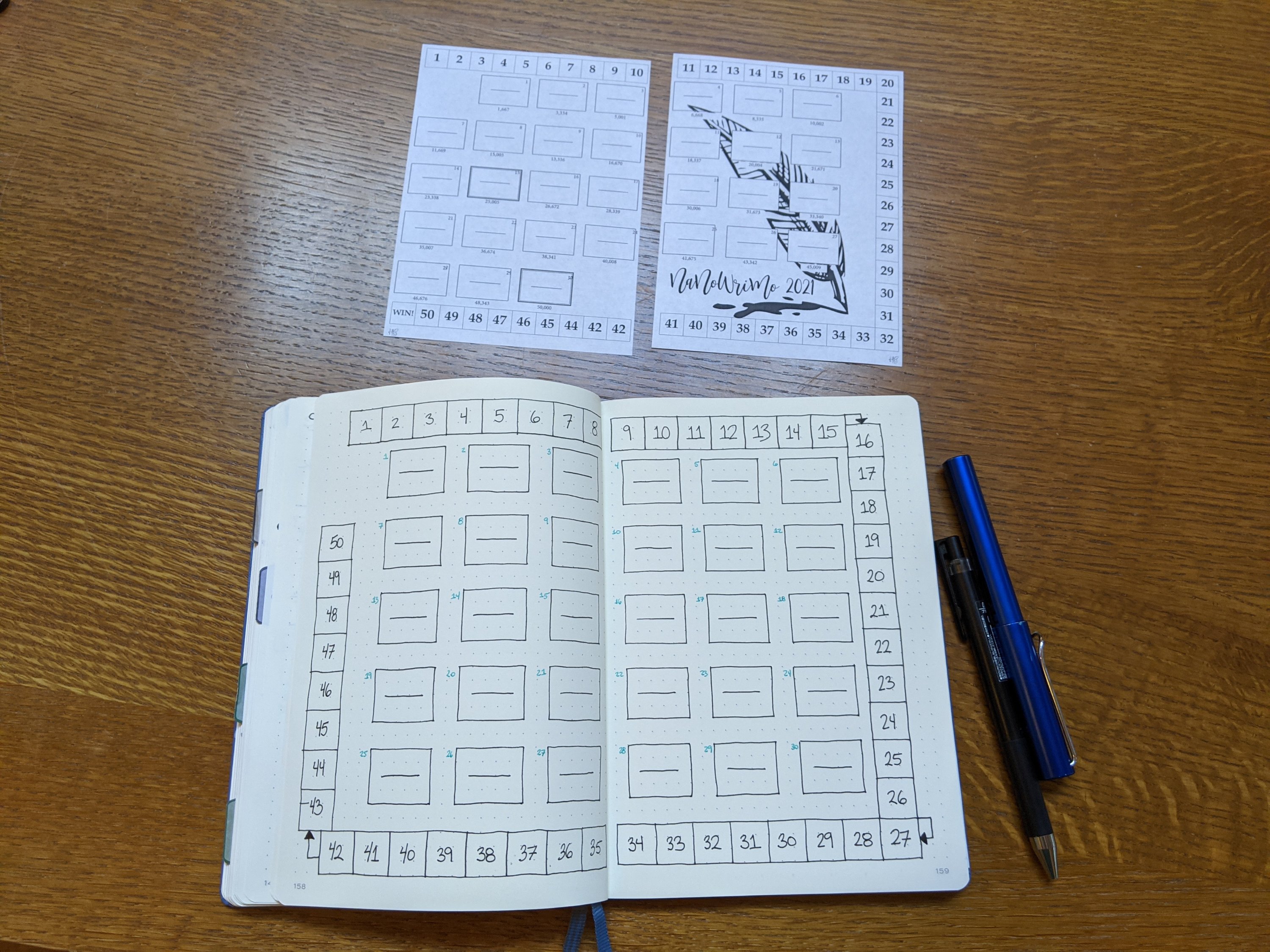
Once I have all this figured out, I may be feeling slightly overwhelmed. So, it’s time to get out my notebook and pens and draw myself a motivational tracker for my bullet journal. Spreadsheets are good for math, but coloring in progress in my notebook is much more satisfying that plugging numbers into a spreadsheet.

As you can see in the picture, I was going to the word count tracker from Sarra Cannon’s Preptober workbook. I printed it out and cut it to paste into my bullet journal and everything. But the daily word count goals in that tracker were already printed on each day. So I ended up drawing my own tracker in my bullet journal, modeled after the one from the workbook. I still need to spruce it up a bit and add milestone markers and daily word count goals, but I’ll save the final version for a future post.

And that’s it. Can you believe it? This is the last of my NaNoWriMo prep posts. I hope you’ve enjoyed this series. I know I’ve enjoyed writing them.

If there’s more writing-related content that you’d like me to post about, let me know in the comments. Otherwise, see you back here again next week when it’s time to set up my reading journal for November! Until then, happy writing!

NaNoWriMo Prep: Organize Your Life

If you’ve been reading this blog for a while, you know I’m a total planner geek. So, bust out your bullet journal or planner and let’s make our NaNo Prep checklist!

As a reminder, the schedule for NaNoWriMo prep is as follows:

  1. Develop a Story Idea (September 12-18) — Click Here to Read This Post
  2. Create Complex Characters (September 19-25) — Click Here to Read This Post
  3. Construct a Detailed Plot or Outline (September 26 – October 2) — Click Here to Read This Post
  4. Build a Strong World (October 3-7) — Click Here to Read This Post
  5. Organize Your Life for Writing! (October 10-16) <— You Are Here
  6. Find and Manage Your Time (October 18-24)

When it comes time to get organized for writing, I start by making a series of lists.

For the first list, I turn to a fresh, blank page in my bullet journal and title it something like “Task/Project Brain Dump.” Then I make a list of all the chores and tasks and other administrative stuff that I know I’m going to have to deal with between now and the end of November. These are things like planning meals, grocery shopping, paying bills, feeding my sourdough starter, cleaning the house, and finishing all the various home improvement projects that are currently important but not urgent but may become urgent before the end of November.

I try to capture everything I can think of in that one place. Sometimes this means going and checking my email for things I’ve snoozed that are going to pop up with a reminder (subscriptions to renew or cancel, emails I need to reply to, events I said I’d schedule and need to follow up on, etc.). One thing I know from experience that always comes up and causes a huge distraction and potential time suck during November is holiday gift planning. So that goes on the list as well.

Once I have my list, I start going through it to see what can be done early (now) and what can be delayed until after November. For example, I may have to wait to clean the house closer to when my guests are arriving, but I can make a meal plan and stock up on groceries now so I don’t have to go shopping as often in November. Similarly, I can come up with a plan for gift giving and/or holiday cards that does not require me spending days researching the perfect book to give each of my niblings when I should be writing. (Yes, I am the aunt who gives books for holidays and birthdays.)

The trick here is that I have to keep in mind that some tasks that I decide really need to be done later (like gift buying, because deals!), are absolutely going to take longer than I think they are going to take, and they have the potential to make me completely lose a day of writing. When the middle of November rolls around, and I’m convinced that everything I’m writing is garbage and words are hard, book browsing is going to be much more fun than book writing, and there goes my word count. This totally happens every year, so I try to keep that in mind and keep those sorts of distractions to a minimum by getting as much done early as possible.

One resource for getting organized that I used last year and am using again this year is Sarra Cannon’s excellent Preptober workbook. It has tips for meal planning as well as worksheets to help you calculate how much writing time you should plan for each day (which I’ll talk more about in next week’s post). I definitely recommend checking out this video which walks you through all of it over on her Heart Breathings YouTube channel.

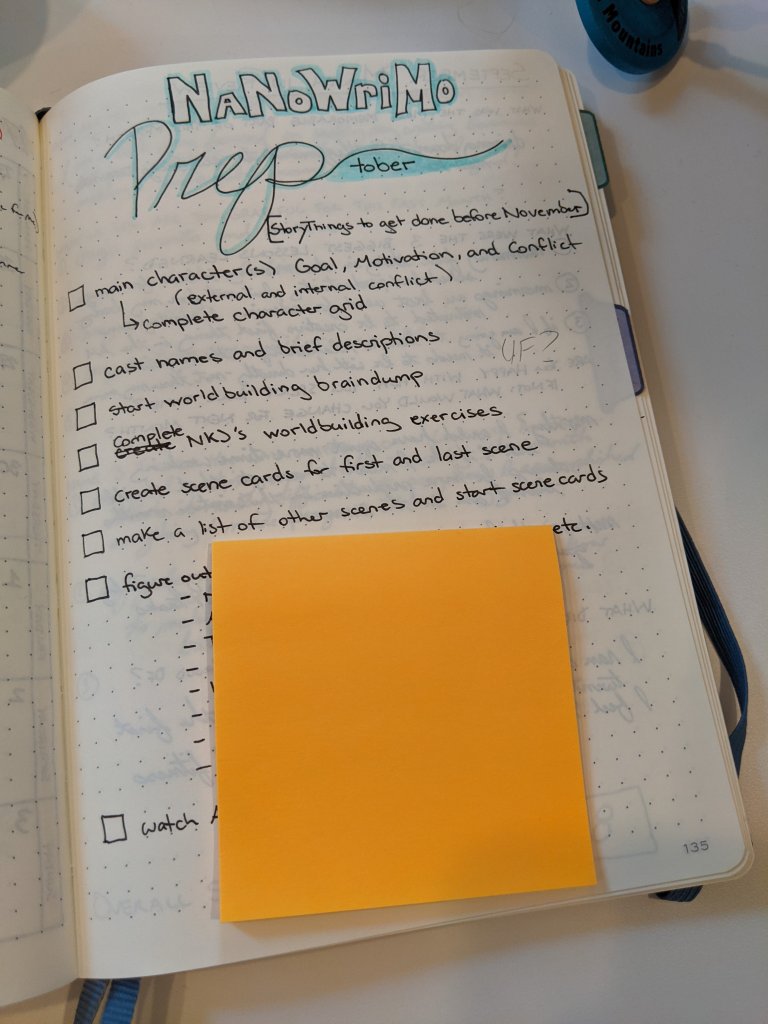
In addition to my tasks and projects list, I also have a list dedicated to the NaNo Prep tasks that I want to try to complete before I start writing. This year’s list looks like this:

Strategic post-it pad placement to cover up the story-specific tasks.

The third list I make is for my writing rewards. I usually have two types of rewards. The first type is either a “you can’t do X until you get Y words written” or a “you can do Z after you’ve hit your daily word count goal” type of goal. Usually it’s a combination of the two that’s geared toward trying to trick myself into getting my words for the day written and complete as early as possible in the day. The second type is the more traditional (and usually bigger) milestone rewards which I usually assign for 10k, 25k, 40k, and 50k words written, plus “first draft done” which is usually around 60-70k for me.

For the first type of reward, I basically go into what I (who don’t have kids) think of as “parent mode” and come up with a set of daily rules to live by that encourage me to prioritize my writing. For example: “you can’t watch any YouTube videos until after you’ve written 500 words.” The key here is figuring out what carrots are going to be the sweetest (metaphorically) when it comes time to write and using those as the incentive.

In the past, I tried using reading time as an incentive, but I eventually realized that doesn’t work for me. It basically ends in me both not writing and not reading. I just find other (admin/chore) things to do that feed my need to procrastinate, then I (at best) squeeze in my word count at the last possible minute of the day and have no time left for what was supposed to be my fun reward. This may be because reading (for me) is more of a relaxing escape from the world than it is an activity that I’m going to be frustrated by not being able to do (unless I’m in the middle of a fast paced book, but those don’t last long enough to work as rewards for a 30-day writing challenge).

Instead, it seems to work better if I use things like social media, YouTube, and casual gaming as a reward because those are the things that I usually don’t want to delay until later. I want to do them when I want to do them. So, if I have to get some number of words in first, I am much more likely to stop procrastinating and make that happen. This means that my rules usually look more like:

  • No Twitter or Instagram until after I’ve met my daily word count goal. (I usually just log out of Facebook completely whenever I’m trying to focus on writing because it almost never “sparks joy” and almost always leads to pointless negative feelings and/or frustrated rage at humanity, and who has time for that, really?)
  • I can watch one YouTube video or play one Magic the Gathering Arena game for every 500 words I write, then I can watch as many videos or play as many games as I want after I’ve hit my daily word count goal.

The second type of goal (milestone rewards) are a lot harder for me. I hesitate to use buying things as a reward for writing words. Similarly, I’m reluctant to use food as a reward. That makes it really hard to come up with good milestone rewards. Usually I just make it up as I go along, or completely neglect this step of my writing prep process. But rewards are important, so I am determined to do better. Right now, I’m on the hunt for good ideas for milestone rewards. If you have any, please let me know in the comments.

All of these lists and rules are a really important part of my planning process, but my favorite part of getting organized to write is setting up my Scrivener file. If I haven’t created it already (back when I was working on plot or character, for example), then I save a new file using a Scrivener template I’ve created that aligns with the beat sheet I talked about back in the post on plotting. This file has descriptions of each beat in the notes section of each chapter. It also has target word counts for each scene/chapter that tally up to my target total word count. Once I’ve saved a copy, I load it up with all the character and world and plot stuff that I’ve been working on, copying over and organizing things based on the notes I made in my notebook.

I can easily lose hours on setting up Scrivener, but having a template with beats and word count targets already set up makes it so much faster to get going. So even if everything isn’t copied over from my notebook perfectly before the first of November, I have the bare bones of what I need to get started writing. This is good because making these lists reminded me how much more I have to do before NaNoWriMo starts. In just over two weeks! Yikes! This month is flying by, and my to-do list has just doubled in size. Time to get back to work. Happy planning!

Starting a Reading Journal for 2021

A little while back I asked for advice on what I should do to streamline my reading tracking for 2021. After posting that, I spent some time thinking about why I track reading metrics, and what metrics, if any, were most important to me. My hope was that, if I could reduce the amount of data I want to keep track of, maybe I could eliminate the spreadsheet, at least.

Then, because I knew that journaling about what I was reading was important to me and something I definitely wanted to add, I watched a bunch of YouTube videos where folks showed off how they set up their reading journals. Turns out that there are a LOT of really inspiring reading journals out there.

Many of these reading journals have extensive artistic collage layouts with lots of washi and stickers, and most include some sort of tracker for “days read.” I’m not sure how artsy I’m going to get with my reading journal, but I did decide to incorporate a few of the more popular spreads, with my own personal twist, of course.

My plan is to use Goodreads as my book database since I’ve already got all my shelves set up so I know what I own and haven’t read yet and if it’s on my Kindle or on my bookshelf. I also use it to keep track of what books I have on hold at the library, and what’s on my TBR. Plus, it’s easy to sort things by number of pages or title or author or whatever. But… I don’t review stuff there.

That’s where the reading journal is going to come in.

Step one: I took a plain (not dotted) Leuchtturm that I had in my stash of blank notebooks, and started covering it with bookish stickers.

Next I took my list of ideas from the YouTube videos I watched and started laying them out in pencil. Once I was happy with what I had, I started inking things in and adding color.

I started with a title page that also serves as a key for my “year in review” bookshelf on the next pages.

I divided the two pages into three “shelves.” My plan is to draw books on these shelves in clumps that correspond to the months of the year, starting in the upper left where you can see that I wrote “January” on the black strip that serves as the top of the shelf. If you look closely, you can see that I’ve penciled in some books on the shelf as placeholders.

Once January is over, I’ll go draw in the appropriate number of book spines in some combination of horizontal and vertical, leaving space for February on the same half of the page. Depending on how many books I read in January, I may just hold off on drawing these in until after February. I’ll add the titles to the spines and then color them in according to genre, adding a little red heart on the spine if the book is also a romance.

Once that was set up, I spent some time drawing a grid to track my reading stats, and making a page for my 2021 reading goals.

My plan is to capture my reading stats each month and then enter the data here. In general, I decided that I wanted to track the following things:

  • Total books read (goal is at least 52, or one per week on average)
  • How many books I read that were published in 2021
  • How many Indie published books I read
  • How many books I read in each format (audio, ebook, and paper)
  • How many books I read that I own vs. that are from the library
  • How many books I read that are written by Black authors and/or other non-white (goal is 12 by Black authors and 12 by other non-white authors)
  • How many books I read with LGBTQ+ main character(s) and/or written by an LGBTQ+ author (goal is 12 books) — Note: I decided not to just make this about the author demographics because, while I strive to prioritize Own Voices books, an author’s sexuality is none of my business.
  • And finally… how many books I read that are YA vs. Adult

I know, it’s still a lot to keep track of and maybe in 2022 I’ll decide to streamline it more. I tried to only keep the metrics I wanted to set goals for, but a couple more (like YA vs. Adult and Indie pub books) snuck in there. I couldn’t help it. I like data.

Underneath my very short list of goals, I added a “21 in 2021” book cover collage. These are the books that I’ve been meaning to get to for way too long. They either get buried on my Kindle, or I’ve walked past them on my bookshelf so many times that I’ve forgotten they’re there. I tried to pick only the ones that I am most excited to read and not focus on stuff that I feel guilty for not reading.

You may also notice that there are only twenty covers pasted in right now. I’m still debating on what book gets that final slot. It somewhat depends on what book(s) I manage to finish before the end of 2020. If you have a book you want to make a strong case for, let me know in the comments.

Finally, I added one more spread for the year before diving into my monthly pages.

I couldn’t resist adding the 2021 Book Riot Read Harder Challenge tasks. I am not going to be actively participating in that challenge this year, but I wanted to add the prompts just for fun. If I do happen to read a book or two that check any of those boxes, I’m planning to write in the page number that corresponds to my notes on that book.

I left the opposite page blank to be filled in with books that I buy in 2021. I’m not sure if I’ll do another cover collage or if I’ll just make a list of titles and authors. I may start off by writing a list in pencil and then going back and adding covers in batches, once I have enough that it makes sense to print them out.

After that, I started a spread for January.

This one is still in-progress. I got a little crafty and used bits of a cute wrapping paper to dress it up a bit. I’m still working on my TBR. Again, it kind of depends on what book(s) I manage to finish before the New Year. I’m thinking of this like a bullet journal, but for reading. So that would make this my month cover page and goals page.

The two pages after this will include a list of what I read in January, plus my January book stats (kind of like a “month at a glance” spread if this were a bullet journal). That will be followed by entries for each book I read with at least a page of notes (and favorite quotes, etc.) from each (sort of like “daily pages” in a bullet journal).

Is this a lot more work than keeping track of my reading in a spreadsheet? Maybe…. But it’s also more fun. Plus, I am attempting to move to using a “regular planner” in 2021, so this will fill the bullet journalling hole in my life.

What do you think? Do you keep a reading journal? If you do, is it artsy? Or do you keep it pretty minimalist? Let me know if you have any suggestions or ideas for me in the comments.

Happy reading!

Setting up my #BuJo for the New Year

It’s the last week of December, so it’s time for me to get my bullet journal set up for January 2018. Since it’s not only a new month, but also a new year, that means I also need to re-do my future log and start thinking about my 2018 goals.

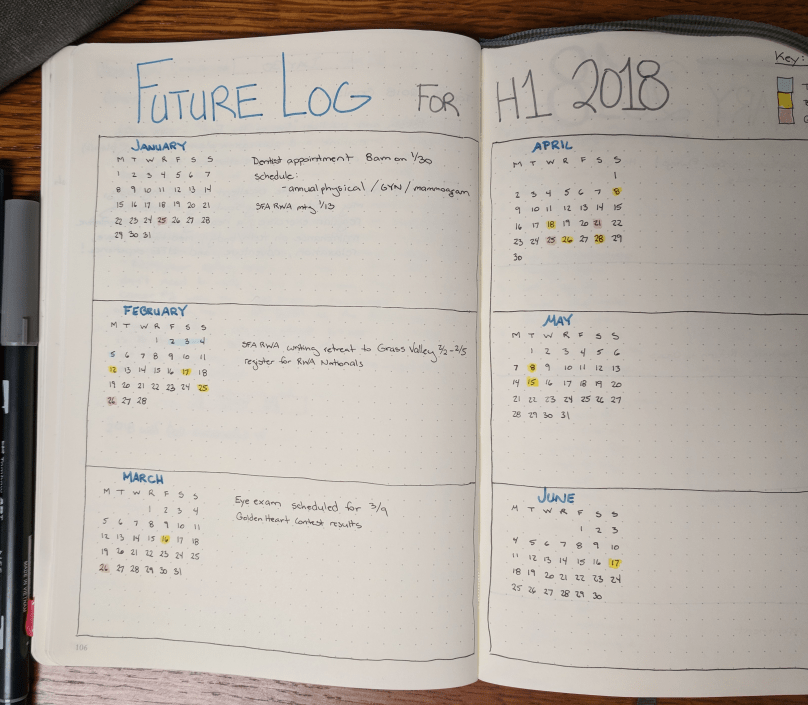
You may remember from a previous post that I’ve been on the fence about the future log. It wasn’t really working for me. But, I came up with a new layout that I think might make it a little more useful. Plus, I have a lot of travel coming up this year that may make this view something I refer to more often.

I love the little mini month-at-a-glance calendars. I’ve started by highlighting birthdays and other important days. Next up, I’m going to start adding in the travel I have planned. But first, I have to nail down a bunch of trip planning.

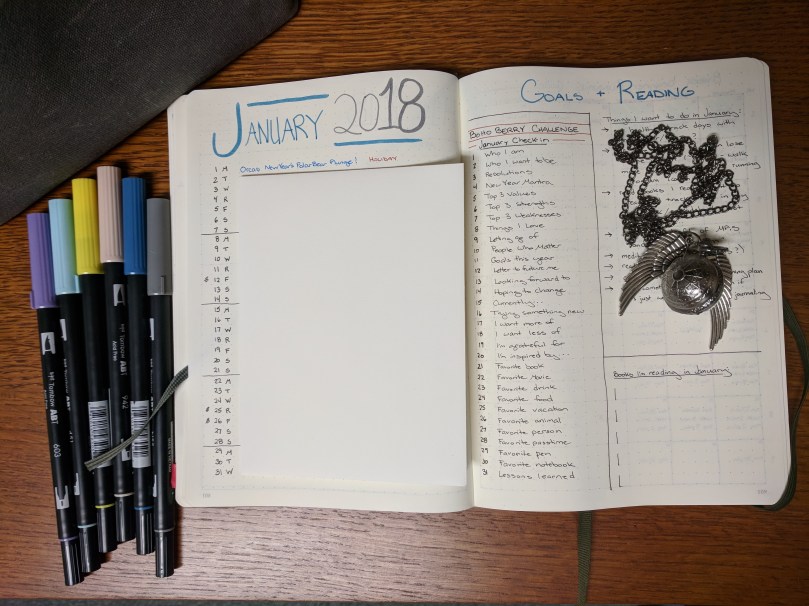
With my future log sorted, I moved on to my January month-at-a-glance spread. It’s pretty standard. Unfortunately, I started filling it in with stuff before I remembered to take the picture. So, I resorted to creative use of card stock and my snitch necklace to obscure my calendar and goals.

There are two things I want to point out on my monthly spread… one is the Boho Berry Challenge prompts for January, and the other is the section I added to track my January reading.

This month, I started using the Boho Berry Challenge prompts for December as a daily journaling exercise. It’s been pretty fun and useful to reflect on 2017 in a slightly more organized fashion. So, I thought I’d try to keep up this practice in January. I’m not posting these publicly anywhere, which is (I think) how you’re supposed to be participating. But, lots of people are. So, if you’re interested in seeing how others are doing their prompts in their journals, definitely check out #BohoBerryChallenge on Instagram.

I’m going to do a whole post on my reading wrap-up for December and reading goals for 2018. So, I won’t spend much time talking about that here except to say that “what I’m reading in January” box was left blank on purpose. The little vertical bars are the start of boxes that I plan to draw around titles that will be written down as I start reading them in January. I know. No TBR. Shocking. Again…more on this later.

Then, I remembered that I had some “bigger than just January” goals for 2018, and I probably should have put that in before I jumped into my January month-at-a-glance. Oh well. I guess that’s what the index is for… So, I added this spread next:

When I took this photo the page on the right was still blank, but I’ve since started adding my 2018 goals on that page. The page on the left is a running training log.

If you’ve been reading my blog for a while, you know that swimming is my main sport. However, due to travel plans and other life stuff going on, I’m not planning to have regular access to a pool for much of 2018. That means it’s time to get back into running shape. However, “walk” days will probably become swim days if I have access to a pool.

I haven’t been running regularly for about seven or eight years. So, I’m being smart about it and using a beginner running guide from Runner’s World. Even though I’m in pretty decent shape for swimming, swimming doesn’t translate well to running, and running doesn’t translate well to swimming. This is why (IMO) it’s pretty rare to see folks who are really good at both running and swimming. So, I’m going to take it slow, but I will say that one of my goals that I wrote on the right side of this page is “run a 10k” in 2018. But, I probably won’t be ready to tackle that until late spring at this rate.

I think that’s all the high-level planning I need to get started in the New Year. So, the next spread is my first weekly spread for January, and it looks like this:

I’ve been using this layout for a couple of weeks now, and it seems to be working for me. I can fill the boxes with day-specific events and tasks. When I’m not busy (like the last two weeks), all my “to-dos” fit nicely inside the boxes, and I don’t even need to break things down to daily spreads.

I’ve left a space in the upper right for my top goals and/or things I want to accomplish by the end of the week to keep it in my face. And, I’m working on adapting my habit tracker to this format. I’m not 100% sure which habits I want to track in January. I already have the running plan spread on the previous page where I’ll be tracking my exercise. So, I don’t think I’ll add exercise here. As I discovered during November’s NaNoWriMo tracking, I hate having to check things off in multiple places. So far, I know I’m tracking reading and writing days. I’ll probably also add “healthy eating” and meditation.

We’ll see how this format adapts to post-vacation life and if it keeps working or if I need to adapt it again.

By the way, if you’re thinking of getting started with your own bullet journal, my local bookstore had a copy of Dot Journaling, so I picked it up to get some inspiration. It’s a pretty great introduction to the expanded world of the original bullet journaling idea and has a ton of great ideas for layouts. Definitely check it out. (PSA: I am in no way affiliated with either of those links and get nothing for recommending them to you. I’m just a fan.)

Happy planning! And happy (almost) New Year!