NaNoWriMo Update With BuJo Word Count Tracker

It is day four of NaNoWriMo, and so far the month is off to a great start. I decided to work on completing the first draft of a project that I had already written over 11k words on. I guess that makes me a NaNo Rebel this year. But, my first drafts are always at least 60k words. So I think this starting early strategy is going to be a really good thing for me. Instead of reaching the end of the month (and of the challenge) but not getting to write “the end” on my draft, this year I may actually hit 50k words written in the month AND get to the end.

I promised in one of my NaNo Prep posts to post an update with photos of the final version of my bullet journal word count tracker. So, let me show you how that turned out and how I’m using it.

The progress bar around the outside shows my progress toward the 50k word goal. I marked each 10k milestone with a sparkle star to remind me that reaching that point qualifies me for one of my rewards. The boxes inside that progress bar (one for each day of the month) are divided in half. I debated what I wanted to put in those. I ultimately decided to go ahead with putting the total words written that day on the top and the total words in the project on the bottom. I wasn’t sure I wanted to do it that way because my total words in the project are not going to align with that 50k progress bar (because I started early). But, I decided that didn’t matter since I’m keeping track of the math in my spreadsheet. I didn’t need to do it here, too.

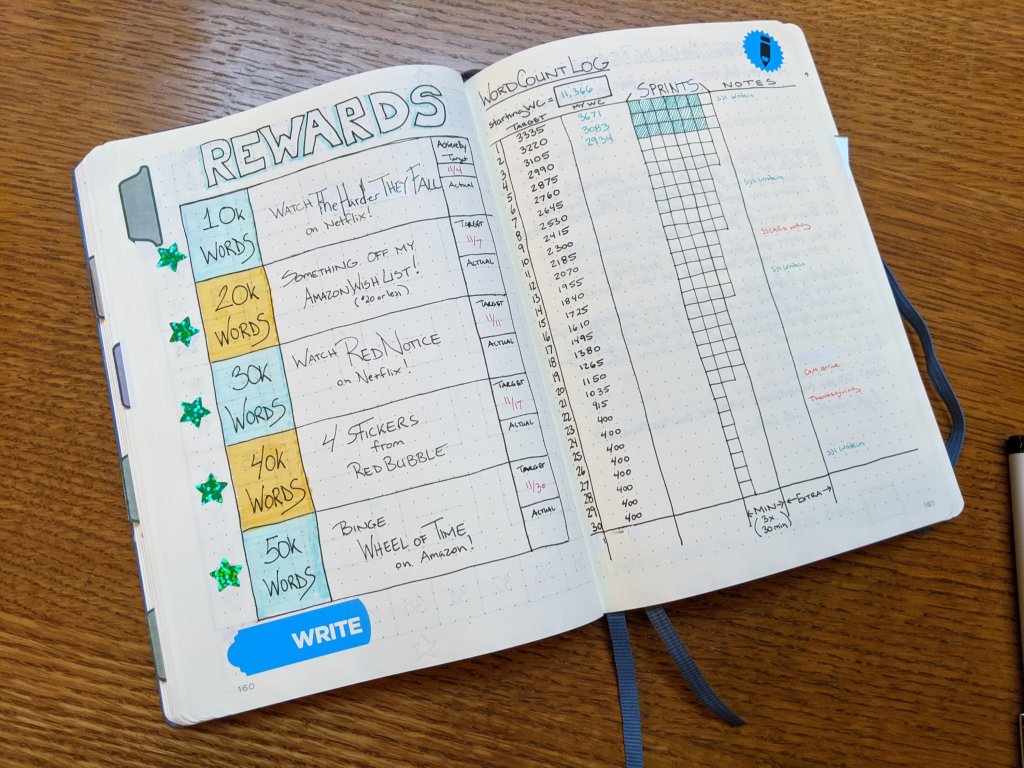
I also created a rewards plan, and a more detailed word count log on a separate spread.

I struggled to come up with rewards and ended up with a mix of new movies / shows I want to watch and fun stuff I want to purchase. I’m rewarding myself for hitting my daily word count with Magic the Gathering Arena, YouTube, and re-watches of favorite movies and/or shows. But there are several new movies and shows coming out in November and December that I’m really looking forward to watching. So, I decided to use those for three of the goals. The release timing worked out to have two movies as rewards for 10k and 30k, while saving the big Wheel of Time series watch until after I’m totally done with NaNoWriMo).

I filled in the other two slots with minor purchases of fun and frivolous stuff. I went with $20 as my wish list spending limit because it’s the reward for hitting 20k words. And I decided on four stickers for the 40k word reward so it would be like one for every 10k words. Neither of these are things I would probably just buy anyway because neither of them are things I really need. I mean, I already have a TON of stickers. But it would be nice to get some new ones for my 2022 BuJo and for my 2022 writing goals planner, which I will probably start setting up in December.

I just hit the 10k words milestone this morning, so technically, I could go watch that movie now. But I’m going to wait until I after I do a few more sprints and hit my daily word count goal.

Speaking of sprints, I added a sprint tracker to my word count log so that I could mark off progress throughout the day. I’m keeping track of my actual word count per sprint on a loose sheet of paper. I may decide to glue that into my planner at some point, but for now I’m keeping it separate. I decided that my daily minimum was going to be three thirty minute sprints. I would need more than that for the first two weeks in order to hit my reverse word count goals. But, if I was really just not feeling it after three thirty minute sprints, I was going to let myself call it a day.

The first two days were great. Day three was a little tough, and today got off to a little bit of a rough start. But, very little of the that had to do with the writing. Plus, once I got going, hitting that 10k milestone gave me a boost of added motivation. Also, I’m in the middle of a big dialogue scene with lots of conflict, and I’m building to this twist that I am really excited about, so that all helps.

If you’re also participating in NaNoWriMo, I hope your writing is also going well! I’ll try to post another update mid-month. In the meantime, happy writing and/or reading!

NaNoWriMo Prep: Manage Your Time

What’s this? A second week dedicated to planning? Sounds right to me. After all, half the battle is finding the time to get the words on the page. Even when you are absolutely not in the mood to write. Probably especially then.

As a reminder, the schedule for NaNoWriMo prep is as follows:

  1. Develop a Story Idea (September 12-18) — Click Here to Read This Post
  2. Create Complex Characters (September 19-25) — Click Here to Read This Post
  3. Construct a Detailed Plot or Outline (September 26 – October 2) — Click Here to Read This Post
  4. Build a Strong World (October 3-7) — Click Here to Read This Post
  5. Organize Your Life for Writing! (October 10-16) — Click Here to Read This Post
  6. Find and Manage Your Time (October 18-24) <— You Are Here

Last week I talked a little about how I try to identify all the tasks and projects that might distract or derail me from my writing. Once I’ve rescheduled, canceled, or delegated everything that I possibly can, it’s time to sit down with my calendar and figure out when exactly I’m going to get my writing done.

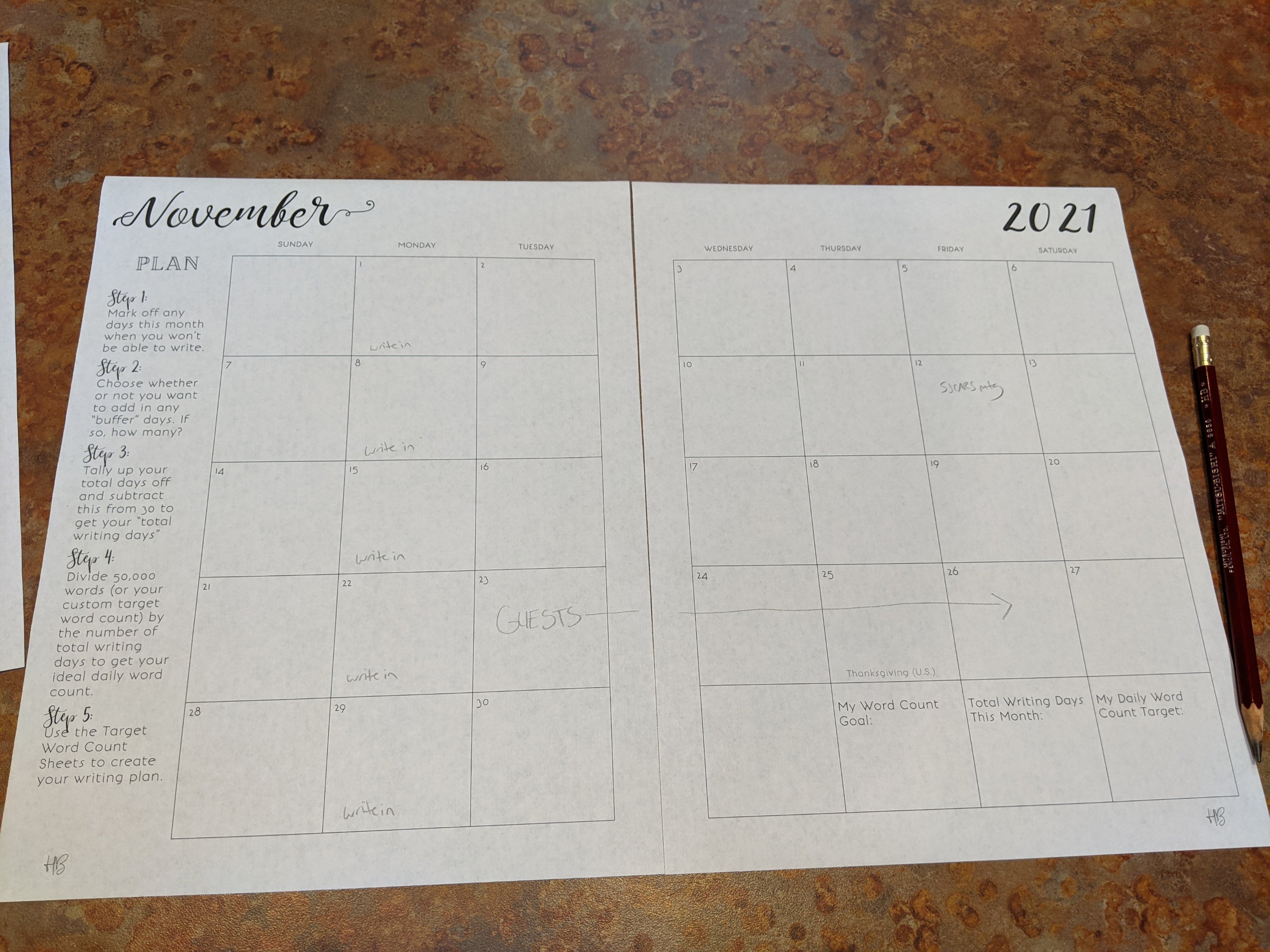
For the first part of this exercise, I used a printout of the calendar from Sarra Cannon’s Preptober workbook to create an overview of the month. This way, I can quickly see which days it is going to be challenging to find time to write, and which days I may be able to squeeze in some extra writing time.

In general, I’m adding only the big, out of the ordinary events to this calendar. I’m assuming that, unless otherwise noted, I just have my usual daily schedule to work around. The first thing I add are my conflicts, anything I couldn’t cancel or reschedule when I was organizing my time for November. Then I add my write-ins. Those may end up being my only dedicated writing time for the day (if it’s an already busy day), or they could represent possible extra writing time, if I also have time to fit in my usual writing sprints on my own.

Once I finish my calendar overview, I transfer those notes over to my word count spreadsheet. You can see a sample of what that looks like here and make a copy of the sheet for yourself to use, if you like. In the sample, I added my write-ins over in the “notes” column in green, and I added conflicts like Thanksgiving in red. On my actual spreadsheet there are more items, but the sample gives you an idea of what I’m doing.

Next, it’s time to do some math and figure out my daily word count goal. But first, let’s pause to talk about word count goals for a minute. Word count is not always the best measure of progress on a project, and it can be really demotivating to hear how many words others can write in a day when you are struggling to even get any writing done. However, when your goal is to “banish the inner editor” and get words (ideas) onto the page so that you can finish the whole draft before going back to make everything better, I think word count is a pretty good metric.

But if you find watching your word count to be completely demotivating, then time working on a project can be a good alternative. Pages or chapters written is another method. Marking milestones by acts or other major plot beats can be a good option. I use and like all these. The key is that you have a good idea of what conversion rate to use (words per page on average, words per hour on average, etc.) so that you have some idea if you’re on track to hitting your goal.

I’m using word count for my daily NaNoWriMo goal, but I’m also doing a conversion on that daily goal so I can estimate how many hours I need to set aside for writing each day. This is where the spreadsheet (or a calculator) really comes in handy.

There are two main strategies for establishing your NaNoWriMo daily word count goal. The first is what I like to call the “peanut butter” method, where you take the word count goal and divide by the total number of writing days to come up with a daily average that you spread evenly across the month (like peanut butter on bread, assuming you’re not allergic to either of those things). This is the traditional 1667 words per day NaNoWriMo target.

The other method tries to capitalize on the fact that you have the most motivation at the start of the month (and probably also the least number of schedule conflicts, if you celebrate the U.S. holiday of Thanksgiving). This method is called “reverse NaNoWriMo.” I didn’t invent it, but I think it’s brilliant. Since I stumbled across it on the internet, it’s been what I try to do most years when I participate in NaNoWriMo.

You’ll find both the traditional “peanut butter” method and the “reverse NaNoWriMo” method in my spreadsheet. I’ve also added a third set of columns which is what I use when I customize my word count goal for each day. I use the custom column to adjust my daily goal for the days where I have conflicts that are going to restrict my writing time. That’s why I put all those events in the “notes” column.

Because of how my schedule is shaping up this year, I am planning on starting with the “reverse NaNoWriMo” word count goals to capitalize on that early motivation. Then when my holiday guests arrive, I’m planning on shifting down to a word count goal that is more like what I can reliably write in one thirty minute sprint. This is where that conversation rate stuff comes in handy.

It’s all well and good to know how many words you want to write in a day. But how long is it going to take you to write those words, on average? My conversion rate is based on how many words I can usually write in one thirty minute sprint. For me, that is somewhere between 300 and 500 words. So I like to use 400 as an average word count estimate for one sprint. There’s a spot in my spreadsheet where I plug in my average words per sprint, and it will calculate how many sprints I need each day to hit that day’s word count goal.

Let’s take the first day of November as an example because that’s the day when I am scheduled to write the most words (my goal = 3335 words). My spreadsheet says that is going to take me about 8.3 sprints (or just over 4 hours). I know I have a write-in that evening, and we usually get in about two and a half sprints during that write-in. That leaves another 6 sprints (3 hours of writing, not counting breaks) I need to find time for earlier in the day. If I can’t find time in my schedule, then I need to adjust my word count target to something more realistic.

This year, I’m actually scheduling writing sprint blocks on my Google calendar so that I know how many hours I need to be writing each day in order to hit that day’s word count goal. Normally, I don’t bother to block out chunks of writing time. I just keep track of my word count goal and squeeze in writing time between other activities after doing a lot of procrastinating. You can guess how well that works.

I’ll probably end up moving those writing blocks around as needed, but I think that having the one or two hour blocks of time sitting there on my schedule will be a good reminder that, even if I put off writing, I’m still going to need at least an hour to write 1000 words. So, it’s probably better to get it done early because I’m not going to find more time in the day.

Once I have all this figured out, I may be feeling slightly overwhelmed. So, it’s time to get out my notebook and pens and draw myself a motivational tracker for my bullet journal. Spreadsheets are good for math, but coloring in progress in my notebook is much more satisfying that plugging numbers into a spreadsheet.

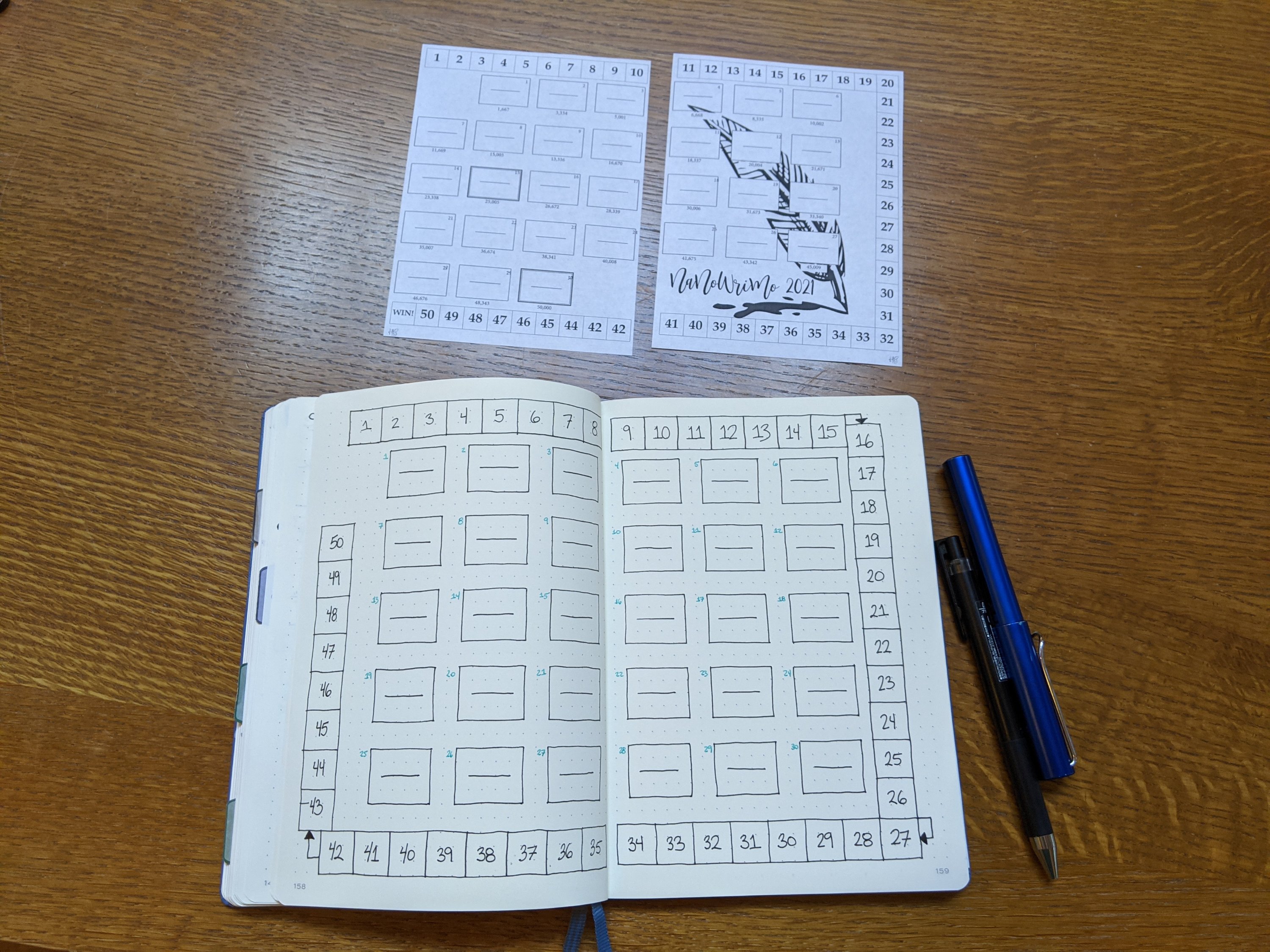
As you can see in the picture, I was going to the word count tracker from Sarra Cannon’s Preptober workbook. I printed it out and cut it to paste into my bullet journal and everything. But the daily word count goals in that tracker were already printed on each day. So I ended up drawing my own tracker in my bullet journal, modeled after the one from the workbook. I still need to spruce it up a bit and add milestone markers and daily word count goals, but I’ll save the final version for a future post.

And that’s it. Can you believe it? This is the last of my NaNoWriMo prep posts. I hope you’ve enjoyed this series. I know I’ve enjoyed writing them.

If there’s more writing-related content that you’d like me to post about, let me know in the comments. Otherwise, see you back here again next week when it’s time to set up my reading journal for November! Until then, happy writing!

NaNoWriMo Prep: Organize Your Life

If you’ve been reading this blog for a while, you know I’m a total planner geek. So, bust out your bullet journal or planner and let’s make our NaNo Prep checklist!

As a reminder, the schedule for NaNoWriMo prep is as follows:

  1. Develop a Story Idea (September 12-18) — Click Here to Read This Post
  2. Create Complex Characters (September 19-25) — Click Here to Read This Post
  3. Construct a Detailed Plot or Outline (September 26 – October 2) — Click Here to Read This Post
  4. Build a Strong World (October 3-7) — Click Here to Read This Post
  5. Organize Your Life for Writing! (October 10-16) <— You Are Here
  6. Find and Manage Your Time (October 18-24)

When it comes time to get organized for writing, I start by making a series of lists.

For the first list, I turn to a fresh, blank page in my bullet journal and title it something like “Task/Project Brain Dump.” Then I make a list of all the chores and tasks and other administrative stuff that I know I’m going to have to deal with between now and the end of November. These are things like planning meals, grocery shopping, paying bills, feeding my sourdough starter, cleaning the house, and finishing all the various home improvement projects that are currently important but not urgent but may become urgent before the end of November.

I try to capture everything I can think of in that one place. Sometimes this means going and checking my email for things I’ve snoozed that are going to pop up with a reminder (subscriptions to renew or cancel, emails I need to reply to, events I said I’d schedule and need to follow up on, etc.). One thing I know from experience that always comes up and causes a huge distraction and potential time suck during November is holiday gift planning. So that goes on the list as well.

Once I have my list, I start going through it to see what can be done early (now) and what can be delayed until after November. For example, I may have to wait to clean the house closer to when my guests are arriving, but I can make a meal plan and stock up on groceries now so I don’t have to go shopping as often in November. Similarly, I can come up with a plan for gift giving and/or holiday cards that does not require me spending days researching the perfect book to give each of my niblings when I should be writing. (Yes, I am the aunt who gives books for holidays and birthdays.)

The trick here is that I have to keep in mind that some tasks that I decide really need to be done later (like gift buying, because deals!), are absolutely going to take longer than I think they are going to take, and they have the potential to make me completely lose a day of writing. When the middle of November rolls around, and I’m convinced that everything I’m writing is garbage and words are hard, book browsing is going to be much more fun than book writing, and there goes my word count. This totally happens every year, so I try to keep that in mind and keep those sorts of distractions to a minimum by getting as much done early as possible.

One resource for getting organized that I used last year and am using again this year is Sarra Cannon’s excellent Preptober workbook. It has tips for meal planning as well as worksheets to help you calculate how much writing time you should plan for each day (which I’ll talk more about in next week’s post). I definitely recommend checking out this video which walks you through all of it over on her Heart Breathings YouTube channel.

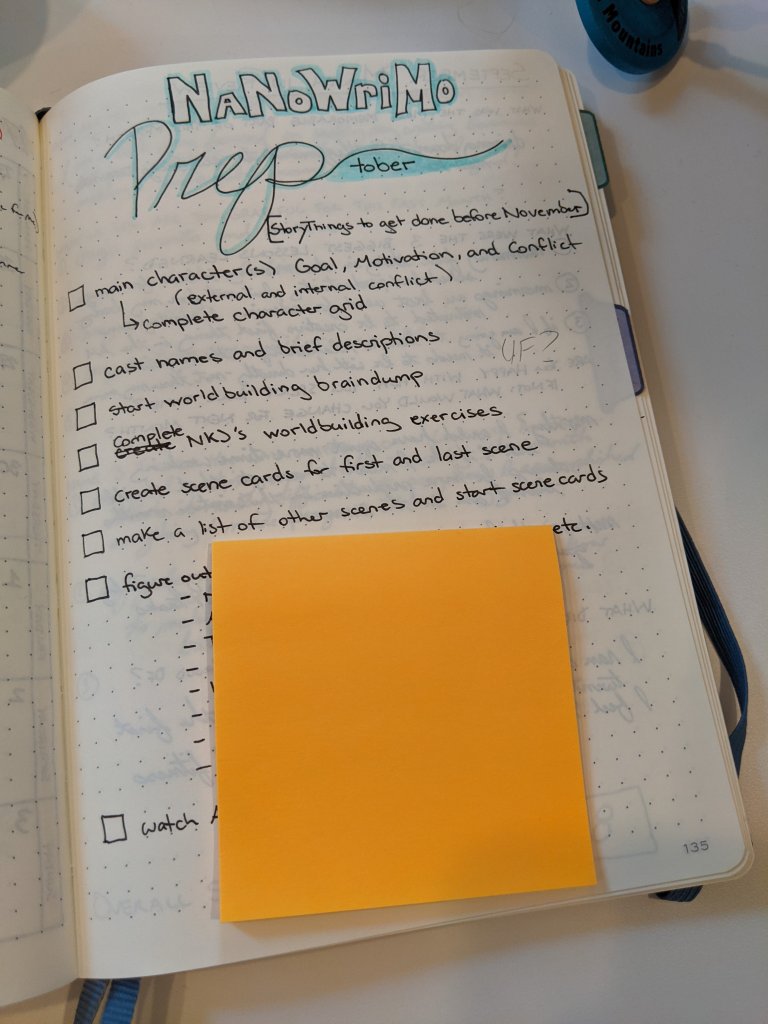
In addition to my tasks and projects list, I also have a list dedicated to the NaNo Prep tasks that I want to try to complete before I start writing. This year’s list looks like this:

Strategic post-it pad placement to cover up the story-specific tasks.

The third list I make is for my writing rewards. I usually have two types of rewards. The first type is either a “you can’t do X until you get Y words written” or a “you can do Z after you’ve hit your daily word count goal” type of goal. Usually it’s a combination of the two that’s geared toward trying to trick myself into getting my words for the day written and complete as early as possible in the day. The second type is the more traditional (and usually bigger) milestone rewards which I usually assign for 10k, 25k, 40k, and 50k words written, plus “first draft done” which is usually around 60-70k for me.

For the first type of reward, I basically go into what I (who don’t have kids) think of as “parent mode” and come up with a set of daily rules to live by that encourage me to prioritize my writing. For example: “you can’t watch any YouTube videos until after you’ve written 500 words.” The key here is figuring out what carrots are going to be the sweetest (metaphorically) when it comes time to write and using those as the incentive.

In the past, I tried using reading time as an incentive, but I eventually realized that doesn’t work for me. It basically ends in me both not writing and not reading. I just find other (admin/chore) things to do that feed my need to procrastinate, then I (at best) squeeze in my word count at the last possible minute of the day and have no time left for what was supposed to be my fun reward. This may be because reading (for me) is more of a relaxing escape from the world than it is an activity that I’m going to be frustrated by not being able to do (unless I’m in the middle of a fast paced book, but those don’t last long enough to work as rewards for a 30-day writing challenge).

Instead, it seems to work better if I use things like social media, YouTube, and casual gaming as a reward because those are the things that I usually don’t want to delay until later. I want to do them when I want to do them. So, if I have to get some number of words in first, I am much more likely to stop procrastinating and make that happen. This means that my rules usually look more like:

  • No Twitter or Instagram until after I’ve met my daily word count goal. (I usually just log out of Facebook completely whenever I’m trying to focus on writing because it almost never “sparks joy” and almost always leads to pointless negative feelings and/or frustrated rage at humanity, and who has time for that, really?)
  • I can watch one YouTube video or play one Magic the Gathering Arena game for every 500 words I write, then I can watch as many videos or play as many games as I want after I’ve hit my daily word count goal.

The second type of goal (milestone rewards) are a lot harder for me. I hesitate to use buying things as a reward for writing words. Similarly, I’m reluctant to use food as a reward. That makes it really hard to come up with good milestone rewards. Usually I just make it up as I go along, or completely neglect this step of my writing prep process. But rewards are important, so I am determined to do better. Right now, I’m on the hunt for good ideas for milestone rewards. If you have any, please let me know in the comments.

All of these lists and rules are a really important part of my planning process, but my favorite part of getting organized to write is setting up my Scrivener file. If I haven’t created it already (back when I was working on plot or character, for example), then I save a new file using a Scrivener template I’ve created that aligns with the beat sheet I talked about back in the post on plotting. This file has descriptions of each beat in the notes section of each chapter. It also has target word counts for each scene/chapter that tally up to my target total word count. Once I’ve saved a copy, I load it up with all the character and world and plot stuff that I’ve been working on, copying over and organizing things based on the notes I made in my notebook.

I can easily lose hours on setting up Scrivener, but having a template with beats and word count targets already set up makes it so much faster to get going. So even if everything isn’t copied over from my notebook perfectly before the first of November, I have the bare bones of what I need to get started writing. This is good because making these lists reminded me how much more I have to do before NaNoWriMo starts. In just over two weeks! Yikes! This month is flying by, and my to-do list has just doubled in size. Time to get back to work. Happy planning!

NaNoWriMo Prep: World Building

This post has been the hardest of the bunch for me to write because I don’t really have a standard process for world-building. It just sort of happens? But I do have some great resources for you, so read on.

As a reminder, the schedule for NaNoWriMo prep is as follows:

  1. Develop a Story Idea (September 12-18) — Click Here to Read This Post
  2. Create Complex Characters (September 19-25) — Click Here to Read This Post
  3. Construct a Detailed Plot or Outline (September 26 – October 2) — Click Here to Read This Post
  4. Build a Strong World (October 3-7) <— You Are Here
  5. Organize Your Life for Writing! (October 10-16)
  6. Find and Manage Your Time (October 18-24)

Okay, so most of the time, because I write sci-fi and fantasy, my world-building starts with these questions:

  • Is this a real-world story or an invented-world (secondary-world) story?
  • If it’s a real-world story, what is/are the speculative element(s) I’m adding (magic, superpowers, futuristic tech, fantastical creatures, etc.)?
  • If it’s secondary-world, is the world primarily sci-fi (science-based) or fantasy (magic-based)?

From there I usually start with the things I know I want to have in my world, and then I ask a bunch of how and why questions to sort out the underlying details.

For example, when I started the Modern Fae series, I knew it was going to be a magic in the real world story. There was a legend I was using as a “what if” jumping off point. So I started with a “if this is true, then how what?” kind of brainstorming session. Based on the legend I was using, I knew there were going to be vengeful spirits and Fae and that the two groups were going to be at war by the time my story took place because of things that happened prior to that first book. I didn’t spend a lot of time working out the details of that beyond what was necessary to get from point A (legend set in the ~1100s) to point B (modern day). I saved the fleshing out of those details for when I eventually wrote Rogue Assassins, which is the sort-of origin story for book one in my series (Eve of the Fae).

From there I started asking questions like “what are the rules of my magic system” and “what do my real-world humans know about these magical elements?” I thought a lot about what it would take to kill or injure or even just weaken the various supernatural creatures in my story. I also had to decide if iron was going to be harmful to my Fae or not because the various legends and superstitions are not all in agreement about that.

Those were the basics, but I came up with more things I needed to sort out after I started writing. Usually, I would get to some thing that was happening in the story and get blocked. Some of those blocks were either character things I hadn’t figured out yet, but most (at least in that first draft of that first book in the series) were world things that I had to stop and consider (or research) and make a decision about. For example, there are some power dynamics between the various types of Fae in my world that become important to the plot. There is also a whole thing I had to figure out about cross-breeding between Fae and humans and other magical creatures. Like, is the off-spring of a Demon and a Fae a Demon or a Fae or some mix of both? Similarly, are the offspring of humans and Fae automatically Fae? What sort of magic do they inherit from their parents? What role do the parents play in their upbringing? How far down this world-building hole do I go before I have WAY more than I need to figure out the plot problem I’m facing?

That last one is the big question with world-building, in general. Most experienced authors and professors will tell you about the iceberg theory. The idea being that there is a sweet-spot for world-building where there is a lot of stuff that the author knows about the world that is under the surface of the story, but only a small portion of that actually goes onto the page.

For a really good explanation of this, check out Brandon Sanderson’s lecture on world-building from his BYU lectures video series on YouTube. (Note: I linked to the one I watched which is from his 2016 lecture series, but this series was updated in 2020 and you can find that full playlist here.) The first half-ish of that video talks about the iceberg theory and is more focused on the how you write world-building than how you create a world. The second half-ish (starting around 30min) gets into more of the how you build a world.

One of the things he does in that video is have his class brainstorm a list of the physical aspects of a world (geology, geography, weather, etc.) and the cultural aspects of a world (government, religion, class, education, etc.). That list is really helpful reference for what is possibly my favorite world-building exercise and the thing that I now start with when I’m building a new world.

Sometime after I started writing Eve of the Fae, I took a world-building workshop where one of the resources we studied was this world-building presentation (link is to slides) given by N. K. Jemisin. I really love her “Let’s Build a World” exercise from that presentation, and I come back to it every time I start to build out a new story world. You can hear her talk about it and actually walk you through it in her Masterclass, if you have access to that. The whole Masterclass is great, and I highly recommend checking it out if you can.

She also talks about the iceberg in the presentation slides I linked to, but her “Let’s Build a World” exercise starts with defining the geography of the world because geography is pretty much at the root of everything. She talks more about why this is the case in her Masterclass. Geography determines weather, it also determines a lot of aspects of culture. This sort of science is not my strength, so I like to brainstorm this stuff with friends and/or family who love to geek out on this type of thing. It’s a great aspect of story to brainstorm because you don’t have to explain your whole story in order for non-writer friends to be helpful.

After geography comes culture. N. K. Jemisin suggests picking three aspects of culture (this is where that whiteboard brainstorm list from Brandon Sanderson’s lecture comes in handy) to focus on. One of those three is your speculative element, or what she calls “Element X. This is what I like to think of as the “secret sauce” of my world. Once you have your two cultural things and your speculative element, you flesh those out both individually (how do they work, why), and then consider how they relate to one another. For example, if you picked education, religion and magic, how does education relate to magic and how does it effect religion?

One tip that I picked up from my world-building workshop which I love is to not only think about what your world looks like from the perspective of people who have “Element X,” but what does it look like to people who don’t? Don’t forget about the negative space. If you have people who worship a god, and you’re writing your story from the perspective of someone who believes, does everyone in that world worship that god? What happens to people who don’t believe? What is life like for them? This is a great way to define additional layers of conflict in your world and your plot, and maybe even in your characters (internal and external conflict).

And one final thing that I try to keep in mind as I write any story, as N. K. Jemisin says in her Masterclass: “If you’re trying to understand what your culture is going to be like based on the environment that it’s developing in, go and research cultures that have developed in that same environment in our own world. But you don’t want to ‘rub the serial numbers’ off an existing culture.”

I love talking about world-building, so let me know in the comments if you have any other great resources you recommend.

NaNoWriMo Prep: (Pantser Friendly) Plotting and Outlining

And now for my favorite thing to talk about… plot! But don’t worry. I am not a pure “plotter” in the sense that, as many times as I’ve tried, I never managed to have my stories fully outlined before I start writing. I’m really more of a “plantser,” if I’m being honest with myself. So this will be a “pantser” friendly post, I promise.

As a reminder, the schedule for NaNoWriMo prep is as follows:

  1. Develop a Story Idea (September 12-18) — Click Here to Read This Post
  2. Create Complex Characters (September 19-25) — Click Here to Read This Post
  3. Construct a Detailed Plot or Outline (September 26 – October 2) <— You Are Here
  4. Build a Strong World (October 3-7)
  5. Organize Your Life for Writing! (October 10-16)
  6. Find and Manage Your Time (October 18-24)

Now on to plotting…

I hinted at this in my previous post on character, but in case you missed it: I love plot. It’s possibly my favorite aspect of a story. That’s right. I said it. As a reader, and as a writer, I appreciate plot more than character. I mean, characters are fun, but if a story doesn’t have a plot, or if that plot is full of holes, I’m out.

Part of me blames my mom for this. She has been a Days of Our Lives fan since before I was born. Growing up, I wasn’t allowed to watch the spicy parts, but she let me watch the rest. And when it was over she would point out all the bits of foreshadowing and talk about what she expected was going to happen in the next episodes. She was rarely wrong. Maybe that means Days (and other soaps like it) are really predictable? Or maybe my mom is just really good? Or maybe it’s a little bit of both? Regardless, it got me thinking and talking about plot at a really young age.

Another early influence for my love of plot came from all the mysteries I read (and had read to me) as a kid. My dad was a big fan of Sherlock Holmes. When it was his turn to read aloud, we usually got a mystery from one of his two big volumes of Sherlock Holmes mysteries. I also read a lot of John Bellairs (author of The House With A Clock in its Walls) mysteries. And what is a mystery without a solid plot? Right?

Most genre novels (except romance) rely heavily on plot. This is probably why I write (and read) mostly genre fiction. But I wasn’t just born knowing how to write a solid plot. Reading and discussing plots gave me good instincts, but I learned how to put that to work in a novel by studying craft books like Save the Cat Writes a Novel and Romancing the Beat. Then I use beat sheets to help me “outline” scenes and to keep me on track when I’m writing.

A beat sheet is a spreadsheet that takes a desired story structure and a target total wordcount and does all the math for you to figure out how many words (plus or minus) you should have in each “beat” of the story in order for your pacing to feel right. Pacing is the gut feel part of plot. In my experience, if the pacing of a book feels off, then there is probably a plot problem.

When I first started getting serious about writing novels, I found this beat sheet from author Jami Gold. I put it into Google Sheets and used that for many years, creating a copy for every new novel I started writing. Then, after I read Save the Cat Writes a Novel and Romancing the Beat, I took that beat sheet and morphed it into a new version that I used for setting up my Scrivener template (more on that when we get to the “Organizing Your Life” blog post).

I use this template to sketch out a rough idea of what goes where. I take all the story idea brainstorming I did and start slotting it into scenes. If you’re not a Scrivener fan, you can do this in a notebook or on notecards or by making a bullet point list in a word doc. Whatever works for you. As you can see in my beat sheet template, I usually divide my project into twenty “scenes” (or chapters) to start. If my target word count is 70k words (a typical length for my lean first drafts), then I expect each of those scenes will average about 3500 words.

When I’m done transferring my brainstorming into my Scrivener template, I usually find that I still have a lot of gaps (blank scenes between two things that I know I want to happen in the story). I mostly ignore those and assume that I’ll figure it out after I’ve started writing, unless there are a lot of gaps at the very beginning of the story (in act one, for example).

I also sometimes end up with ideas from my brainstorming that I know I want to happen but that I’m not sure where to put based on the story structure. All of those ideas end up on a “scene ideas” list to slot in later. That list is one of the first places I revisit when I get stuck after I start writing.

Before I start writing, I try to make sure I know the following at a minimum:

  • Where the story starts — The set up and the intro to the main characters for sure, but also the “meet cute,” if I have one, and the inciting incident. Ideally, I want most of act one figured out, even if the “Debate” beat is still a little fuzzy.
  • Where the story ends — What is the ideal end state for my characters and my plot? Did they defeat the villain / solve the mystery? Did everyone survive? Is there a happily ever after or a happy for now ending? I may not know exactly what those “Finale” and “Final Image” beats look like, but I have a general idea of what needs to happen there.
  • The key things that definitely need to happen in order to get from point A (the beginning) to point B (the desired end state) — This could be a bullet list organized by act, or by beat (ex: the main character needs to learn how to use their magic, so I need a training montage, and that probably goes somewhere in the “Fun and Games” beat)

Mostly, I’m using logic at this point in the plotting stage. If this has to happen, then what needs to happen before that? And for a long time, that was it. I’d get my logic figured out and get to writing. Then I read Story Genius, and now I also try to make scene cards for each scene instead of just making a list. This way I can make sure that my plot isn’t running away without my characters. I also find they’re really helpful for getting me unstuck. But, I usually don’t fill those in until after I start writing.

The thing is, as much as I love organizing my plot points, pretty much all of this can also be done after you write. I have totally taken a story that wasn’t working and retroactively applied Story Genius scene cards to it in order to figure out why and make changes. You end up cutting more scenes (and having to write new ones) that way, but you can still have a solid plot and be a discovery writer. This is the way I do it (most of the time) because the idea of writing stuff I don’t need makes me itchy, but I also know that I do not have the patience to complete a full outline before I started drafting.

Let me know in the comments if you’re a plotter, pantser, or plantser, and/or if the beat sheets I shared help you with your NaNo prep. Since today is the last day of September, my September reading wrap-up and October reading journal set-up are coming soon. Maybe this weekend. Then, next week we talk about another favorite of mine, world-building! Until then, happy Preptober!

NaNoWriMo Prep: Creating Complex Characters

Characters are the life blood of any story. Most readers will tell you that they’ll forgive a few plot holes and less than amazing world building if you give them characters that just leap off the page and into their heart. So creating complex, compelling characters is kind of critical. No pressure, right?

As a reminder, the schedule for NaNoWriMo prep is as follows:

  1. Develop a Story Idea (September 12-18) — Click Here to Read Last Week’s Post
  2. Create Complex Characters (September 19-25) <— You Are Here
  3. Construct a Detailed Plot or Outline (September 26 – October 2)
  4. Build a Strong World (October 3-7)
  5. Organize Your Life for Writing! (October 10-16)
  6. Find and Manage Your Time (October 18-24)

Now, let’s talk about characters.

When I first started writing, world-building and plot seemed to come much easier to me than characters. I felt like character was my weak spot. So, I searched out the people who do character best — romance writers — and started learning.

The way I see it, romance books are all about the characters. The plot and the world are really secondary. If the reader doesn’t love the characters, they are not going to care how cool the small town is, or how fantastic the magic is, or how bizarre the aliens are. And the reader is not going to care if those characters achieve any of their goals, let alone their happily ever after.

This is why I decided that if anyone could teach me the secret to creating compelling characters, it would be romance writers. As an added bonus, I found out that the romance community is generally a pretty welcoming bunch of folks who are happy to share their knowledge with newbies, even (or especially) ones who don’t have a degree in English literature.

I started attending romance writing conferences and workshops. I entered contests, and eventually I joined a local romance writer group. I took notes, collected character building templates, and basically absorbed as much as I possibly could about how to write compelling characters.

Luckily for me, it turned out that the secret was NOT in creating that basic character bio stat sheet. I am terrible at keeping track of (or even sometimes describing) things like my characters’ eye color and hair color and favorite food, etc.

The secret is that a main character has to want something. The romance writers taught me about GMC (Goal, Motivation, and Conflict). Specifically, what does the character want? Why do they want it? And what’s standing in their way?

My favorite example from these character workshops is Disney. Think about your favorite Disney princess film. (Tangled. It’s Tangled, right? That’s the correct answer.) Did you ever notice that every Disney princess has an “I Want” song? They’ve got a dream.

Vladimir from Tangled makes his little ceramic unicorns kiss
Even though I love Tangled, this concept is probably best illustrated by The Little Mermaid and her song about wanting to be where the people are

But there’s more to GMC than having a dream. Just when I thought I had this nailed, the workshop instructors threw in an essential curve ball. It’s not only about the character’s external GMC. There’s also an internal need or flaw that needs to be reckoned with before the character can achieve their goal. This can be conscious or unconscious. Some people describe it as the “lie the character tells themselves” or their misbelief about the world (or themselves).

It’s been a while, so I can’t remember which one of those many romance writing workshops this came from, but after learning about GMC, I started filling in a grid like this for each of the main characters in my novel:

GoalMotivationConflict
External story goal:
Why?
Why now?
External obstacles:
Internal need:
Why?
What holds the character back?

That helped a lot, but I still hadn’t quite made the connection between characters and plot. That didn’t happen until I read Story Genius by Lisa Cron. After reading Story Genius, a whole bunch of puzzle pieces about story craft just sort of clicked into place in my head. I think the thing that did it was this idea of “the third rail” in the story. It’s sort of the “why do we care” aspect of story. It forces you to think about why what’s happening on the page (the plot) matters to the character. Everything that happens gets tied back to the characters’ internal and external conflict.

L. Penelope has a downloadable Story Genius scene card template on her website, which is what I use, but I’ll talk more about that next week in my post about plot. If you struggle with character, and you have time to read one craft book before NaNoWriMo starts, I highly recommend checking out Story Genius and implementing scene cards in your NaNo prep.

Back to character creation, even though I usually start by free writing and brainstorming in a notebook, once things start to come together I create a character sheet in Scrivener for each of the main characters in my book. However, I usually end up deleting the pre-populated prompts on Scrivener’s character bio sheets. I start my character bios by copying over any relevant notes from my notebook. Then I add my GMC grid at the top of the sheet. I also write down any other important details that I need to remember as I’m writing (ex: things I’ve said about that character in previous books that is now cannon and should not be contradicted).

Last, but certainly not least, comes the fun part. Because I struggle with character descriptions, I like to find photos of celebrities who look similar enough to how I picture the character in my head that they can stand in as an avatar. Then I add a few photos to my character sheet. That process takes a lot longer than you might expect because I don’t pay that much attention to celebrities. So I struggle to remember the names of actors and actresses or other performers. That makes coming up with search terms difficult. If you’re a pro at coming up with images for your characters, please tell me your tips and tricks!

Similarly, if you’ve learned something creating compelling characters that you want to share, let me know in the comments. I’m always looking to learn new things. As an example, I’m currently reading about a concept called “universal fantasies” and how that relates to both plot and character. I’m still learning, but maybe I’ll talk more about that in next week’s post.

NaNoWriMo Prep Time: Story Idea

It’s that time of year again! Time to get ready for the biggest and best writing month of the year — November!!! It’s countdown to National Novel Writing Month (NaNoWriMo), friends!

If you have never heard of NaNoWriMo, it’s a one month writing challenge that surrounds you with a community of others who all want to write a novel. All you have to do is commit to (at least trying to) write 50,000 words in 30 days. That’s the length of a very short novel (ex: The Great Gatsby).

I’m not going to spend any time talking about why you should or shouldn’t participate. There are plenty of other blogs and articles for you to read if you’re curious about that. I’ll just say that I love NaNoWriMo.

What I like most about NaNoWriMo is the built-in community aspect of it. Writing a novel is a lonely slog, no matter if you’ve never written one or if you’ve written hundreds. You have to get those words on the page in order to turn your brilliant idea into a book, and even experienced authors struggle with that. At least in November, I know there are millions of others who are writing alongside me. We’re all in it together and cheering each other on.

This post (and the others that I’ll post in the coming weeks) are focused on the prep work that goes into writing a novel. Since it’s officially NaNoWriMo prep time, and I am currently in the process of solidifying my own idea and getting it ready to write in November, I thought it would be fun to share a little about my process here on my blog.

Note: I’m not going to talk about what I’m actually writing in November. (I don’t usually talk about what I’m writing until after the first draft is done, except with my newsletter subscribers.) But, I will tell you about my process, with the obligatory caveat that process is personal and sometimes one person’s process changes from story to story. Basically, don’t listen to anyone who says you must do it a certain way or you are not a “real writer.” There is no “right way” to write. You do you.

Also, if you are not a writer and/or you’re not curious about writing process, then just skip these posts. My reading wrap-up and reading journal posts aren’t going anywhere. This is just a little additional content for folks who are interested.

Now that all that’s out of the way, let’s get started. The schedule for NaNoWriMo prep is as follows:

  1. Develop a Story Idea (September 12-18)
  2. Create Complex Characters (September 19-25)
  3. Construct a Detailed Plot or Outline (September 26 – October 2)
  4. Build a Strong World (October 3-7)
  5. Organize Your Life for Writing! (October 10-16)
  6. Find and Manage Your Time (October 18-24)

As you can see, this week’s prep task is to develop your story idea. If you’re anything like me, you have a million story ideas floating around in your head at any given time, and you’re probably thinking, “but which one do I choose?”

The answer for me is that I try to pick several that might fit together and then mash them all into one novel. I know that sounds messy and like it would never work, but here’s the thing: novels are long. (Shocking observation. I know.) They’re also complicated. They really need more than one idea to sustain them.

You need multiple characters, and they all have to feel like they could be the main character of their own story. You need a main plot and sub plots and character arcs and interesting world-building. You need stuff to keep you going when you get stuck. So, I say, the more the merrier when it comes to ideas.

But even if I’m planning on using more than one idea in my novel, how do I pick which ones to use?

One thing I like to think about is what sort of stories I’m really drawn to at the moment. Making lists really helps here. I make lists of my favorite “comfort food” movies. I write down everything I’ve watched or read lately that I just can’t stop thinking about. I think about the settings and tropes that appeal to me.

Then, once I’ve done that, I step back and have a look at all of it. I try to identify any commonalities or trends. I consider which, if any, of those things would work as a plot or a setting or a trope for the main character(s) that are bouncing around in my brain.

Or, sometimes (most of the time), I have a plot and/or setting idea already, but I don’t have my cast of characters figured out. In those cases, I brainstorm lists of my favorite heroes and/or heroines. I think about why I like them. Am I drawn to stories about outcasts and underdogs (ex: Katniss Everdeen)? Or do you I competence (ex: James Bond)? (Answers: yes and yes). I list my favorite ensembles and try to identify what they have in common (ex: are they mostly small groups of close friends, or found family, or actual families, or sports teams, etc.)?

Finally, I make sure to spend some time thinking about the elements of a story that make me auto-click or auto-buy. This could be genre, at a high level, but it is also more specific elements found within and across genres. As an example, one of the things I talk about in my reading recaps is that, while I love sci-fi and fantasy in general, I’m a sucker for an academy story. I also love training montages. (I actually love both of those things regardless of genre, but hopefully you get my point.)

A few months ago, when I realized that I was going to be wrapping up my Modern Fae series (at least as far as the current series arc goes), I dedicated one of my many blank notebooks to being the place where I keep lists like this.

This works for me because I love writing things in notebooks (and also I’m spending most of my time at home). You may prefer to keep lists like these on your phone or on your computer. It doesn’t matter where you put them, so long as they are easy to find when you need to add to them and you have a place to put new ones that you create. For example, we haven’t even talked about listing favorite magical creatures, or types of magic, or romantic pairings, or…. you get the idea. You never know what’s going to be helpful when it comes time to work on your novel.

This week I’m working on my lists in my spare time, and seeing what fits with the core ideas I have for the story I want to write in November. I’m trying not to get too bogged down thinking about specifics, but I did go on a bit of a tangent earlier in the week, trying to come up with names for my characters. At some point, all of these elements of prep start blending together and building on each other. But, for now I’m trying to stay at a high level and pin down the vibes I want for my story. Next week, we’ll talk more about characters.

Let me know in the comments if you’re planning on participating in NaNoWriMo this year and if this is your first time or how many years you’ve participated. If you want to be buddies on the official website, here’s a link to my profile: https://nanowrimo.org/participants/emenozzi.

August Reading Wrap-up

August turned out to be another big reading month. I ended up reading six books, evenly divided between fiction and non-fiction. I also managed to actually write down my thoughts in my reading journal for nearly all of the books I read this month! Big wins all around! (Except for the writing. Don’t ask about how the writing went.)

What I read in August:

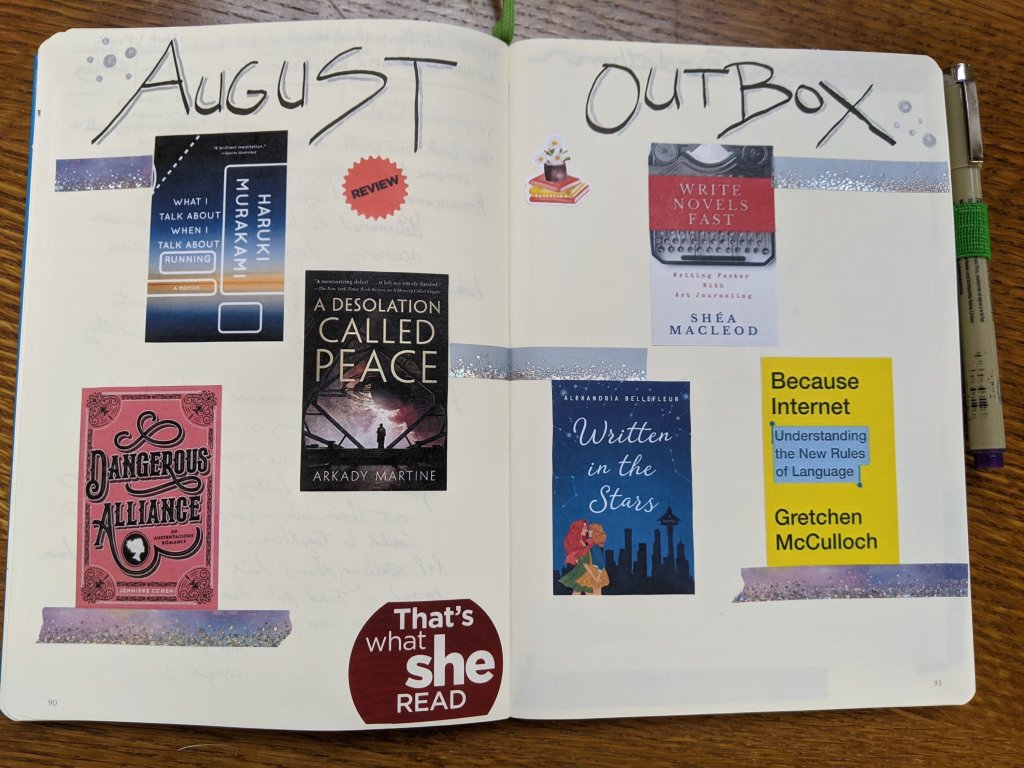
  • Dangerous Alliance by Jennieke Cohen — This was a cute historical romance that also has a mystery sub-plot. I enjoyed it while reading it, but have pretty much forgotten almost everything about it since then. The heroine is a fan of Jane Austen (who is alive and publishing in the year this story takes place), and when she is confused about what to do she often considers what her favorite Jane Austen heroines would do in her place. If you like historical romance in general and Jane Austen in particular, I recommend checking this out.
  • Write Novels Fast: Writing Faster With Art Journaling by Shéa MacLeod — At only 36 pages, this barely qualifies as a book, but it’s listed in Goodreads, so I’m counting it. I was in a bit of a creative slump when I picked up this book and needed some inspiration. There were just enough ideas in here to motivate me to dust off the notebook I’ve been using as my brainstorming / character building / plotting notebook for my Modern Fae series and get back to work. I’m not convinced the tips in this book are going to help me write any faster, but they did help me move past a creative block.
  • What I Talk About When I Talk About Running by Haruki Murakami — I can’t remember if I bought this for my husband several years ago, or if my mom bought it for him because I said I thought he might like it. Either way, it’s been sitting on our bookshelf for a while. I decided to pick it up to see if it had any words of wisdom that might help motivate me to step up my running game. It turned out that it did. Plus the author made really insightful parallels between running and writing. So, that was great! My only complaint is that something about the narrative voice makes it sound like the author thinks that the audience for this book is exclusively men. That was super annoying.
  • A Desolation Called Peace by Arkady Martine — I really enjoyed this follow-up to A Memory Called Empire. The story picks up shortly after the events at the end of the previous book. Even though that book could have been read as a stand-alone, it was nice to see what happened next. If the first book was, at it’s heart, a “whodunnit” murder mystery, this is mostly an alien-first-contact story. But, like the first book, there is a LOT of other stuff going on, including all the politics and struggles of those who find themselves trying to “do the right thing” within or in the face of a large and aggressive empire. Meaty sci-fi! Yum!
  • Written in the Stars by Alexandria Bellefleur — This was a pretty light and fluffy contemporary romance that was a very loose f/f retelling of Pride & Prejudice. I think I expected the plot to be a little more of an actual retelling than it turned out to be, so that was a little bit of a disappointment. Also, there wasn’t really any other plot besides the romance plot, which I wasn’t expecting. The romance plot was good, and I enjoyed the characters. I’ve just come to expect an external conflict in addition to the internal conflict in the contemporary romance books I read. It’s nice to see two characters falling in love, but I also want them struggling to accomplish something else, too.
  • Because Internet: Understanding the New Rules of Language by Gretchen McCulloch — This book was fantastic. My husband and I listened to it on our recent road trip. It kept us both engaged and sparked a ton of discussion. The audiobook narration was really easy to follow, even in places where the author/narrator is trying to describe specific uses of repeated letters and unusual punctuation. Though, it did help that I happened to also have a copy of this on ebook. That way I could look up anything that I wasn’t sure I fully understood from the audiobook. If you are at all interested in language and looking for insights into how informal communication has evolved through the decades, I highly recommend checking this out.

In case you are curious, I also updated the bookshelf overview page in my reading journal. I really like how it’s turning out. As a reminder, the colors on the spines represent genre, and the little hearts signify which of the books are romances.

It always feels like I’m reading a lot of romance, but if you count the hearts on the spines in the photo, I’ve only read nine so far this year. And that’s out of forty-three books read, total.

Also, wow! I’ve already read forty-three books so far this year! Only nine more books until I reach my annual goal of fifty-two total books read. I’m not going to change my Goodreads goal, though. I have two first drafts of two different novels that I want to finish before the end of the year (and I did not get much writing done in August). Plus the holidays are coming up. So I need to step up the writing and cool it with the reading, at least until after I get my work done each day.

What are you reading? Are you also doing the Magical Readathon in September? Let me know in the comments.

Rogue Assassins — a FREE Modern Fae Novella

Stuck at home and looking for something to read? If you already love my Modern Fae series, or if you’ve been curious about it but haven’t quite gotten around to reading any of my books yet, this post is for you.

Growing up, I got an early introduction to serial storytelling via Days of Our Lives. I was way too young to be watching it, but my mom was a huge fan. Sometimes she let us watch along with her (but we had to close our eyes during the “sexy times”). She’d talk to my sister and I about the various plot threads and speculate on what was going to happen in the story. I think somehow this early exposure planted the idea in my head that someday I wanted to try writing a story in a serial format.

Well, friends, that day has come. I’ve been playing with this story idea for a while now, and I’m making it happen. The first episode is dropping TODAY.

I spent a lot of time (probably too much time) trying to decide how best to distribute these episodes. Since this blog is mostly about what I’m reading, I didn’t want to post episodes here. I also didn’t want to spam my mailing list with weekly episodes in case some might prefer to read the whole thing after it’s complete rather than reading a chapter a week. So, I ultimately decided to have a dedicated mailing list for this story. You can sign up for that here: http://bit.ly/RogueAssassins.

What can you expect if you sign up? Here’s what I’ve got planned:

  • One episode per week, for about 20 weeks, total
  • A fantasy adventure with some kissing
  • A heroine who will do whatever it takes to save her sister from the toxic love of a power hungry man
  • An ambitious shapeshifting hero whose future depends on the heroine’s success
  • An explanation about what was going on with that pair of gargoyles who made a brief appearance in Eve of the Fae
  • Answers about what actually happened to the Faerie Queen Godda when she disappeared
  • Much drama! Some characters will die, some will find love, all will be changed forever
  • An interactive approach to story-telling (I welcome your comments and feedback on each episode)

This is going to be as much of an adventure for me as it will be for you. I am so excited to try this! I hope you love the first episode and decide to subscribe and join me on this journey.

Oh, also… if you want to grab a copy of the first book in my series, Eve of the Fae is on sale for only $0.99 this weekend. Buy one for yourself, or for a friend, or just help me get the word out. I’d really appreciate it.

January 2020 Bullet Journal Set-Up

And now a break from the reading summaries, stats, and updates to share my bullet journal spreads for 2020. Unlike most, I don’t bother starting a new notebook at the start of a new year. If I still have pages left in my current notebook, I just keep going.

Before diving into my 2020 spreads, I used almost ten pages planning my 2020 writing schedule and goals which I’m not showing here. In general, I laid out a future log for the entire year, four months to a page, divided horizontally so I had space for mini calendars on the left and notes on the right in each box. Then I used pencil (not normal for me) to start putting in rough plans for what writing project(s) I wanted to be working on each month.

In addition to that, I came up with two major writing goals for the year. One is a revenue goal and the other is to “build my backlist.” After that, I made sure my Q1 goals and projects tied to my 2020, and that’s it. All that’s left is to set up some sort of Kanban board to track my tasks associated with those project and make sure it all gets done. With that more or less set up, I moved on to my reading goals for 2020.

I’m keeping it pretty simple with this two page spread. On the left side, I can keep track of new books that I want to put on hold at the library (or add to my wishlist). There’s an 8×8 box for each month, and I’m writing the release date and title in each box for the books I’m excited about. On the right side, I’ve listed my reading goals for the year (which I’m going to talk about more in a separate post). Then I’m using the bottom half of the page as a tracker for the books I’ve purchased to make sure I’m buying and reading books rather than buying and hoarding them.

Next up is my month at a glance. I like the traditional line-a-day view for this. I’m putting my regular life events on the left side and my writing business stuff on the right side. I also have a little habit tracker on the left side for the four habits I’m tracking in January (vitamin, meditation, cardio, and stretching).

The right hand side also has a mini habit tracker because I have a goal of writing 1000 words every day in January. They can be in any of the three Modern Fae projects I’m currently working on, but blog posts and outlining and brainstorming don’t count. It has to be part of a story scene, even if I eventually end up cutting it from the finished product. Ultimately, I want to see if I can keep this up all year, but I’m going to take it one month at a time so I don’t get overwhelmed by my ambition.

On the next page, I have a big blank page for capturing what I read that month and any favorites from my “culture consumed” (like podcasts, music, movies, tv shows, etc.). I’m not sure exactly what this will end up looking like, but I’m intending to try to make it a bit of a collage. I’m thinking of printing out mini book covers to paste in, or maybe doodling the covers of the books I’ve read. I’ll probably add ticket stubs from movies, if I go to any. I’m leaving plenty of space to be creative and have a bit of fun.

I’m also trying something new this month. I’ve never done a mood tracker before. I thought it might be helpful to be able to visually compare my mood to my movement, so I came up with the idea for this chart.

The days of the month are across the bottom. Number of steps are on the vertical axis alongside a very basic mood scale from “no good very bad day” to “everything is awesome” with “meh” in the middle. I’m using some symbols to track what kind of movement I’m doing for my daily cardio (for me this means at least 30 minutes of continuous movement). I’m really curious to see how this turns out.

One of the reasons I wanted to try a mood tracker this month is because I’m not great at being mindful about how I’m feeling. I’m hoping this will force me to stop and think about it at least once a day. I suspect I’ll feel better on days I move more, but who knows. Maybe I won’t. It will be interesting to find out.

The final new thing I’m trying this month is this reference page just before I start my daily pages where I can do some meal planning and write down admin tasks that need to get done but that I don’t want to add to my daily log for whatever reason.

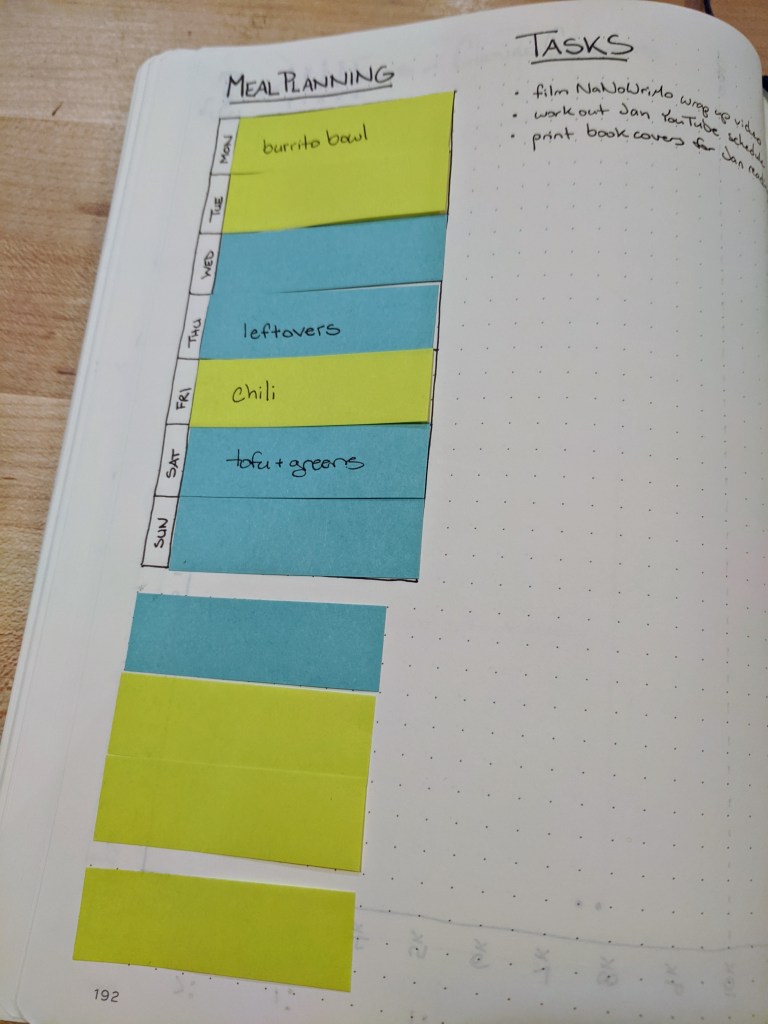
I have these little post it flags that happen to be almost exactly 3×10 squares. So, I made a week and then started writing some of our regular meals on the flags. This way I can move them around and re-use them throughout the month. The lime colored ones will be crockpot recipes and the blue ones will be for everything else. That way if I know I need a crockpot recipe on a certain day (because I won’t be home until late, for example), I can see at a glance that I’ve got myself covered. I’m hoping this will also help me stay on top of groceries for the week.

And that’s it. That’s my set up for January. I don’t like using weekly spreads. I keep trying them and then hating them for a variety of reasons. I like the flexibility and the focus of daily logs. So, that’s what I’m sticking with for January. I definitely lean more towards the traditional bullet journal method rather than the “instagram friendly” bullet journaling that gets featured a lot on YouTube and elsewhere. But, if you like this sort of thing, let me know in the comments, and maybe I’ll do more posts like this.